Srbija
 Hrvatska
 Slovenija

Qualified majority voting could smooth EU accession path for Western Balkans


Broader use of qualified majority voting within the European Union could simplify the membership pathway for future Western Balkan candidates by limiting the ability of individual member states to block progress over bilateral or domestic political matters. However, such structural reform would not eliminate the core requirement for accession: implementing domestic reforms within candidate nations.
The European Commission is preparing a detailed analysis of the policies and institutional changes needed to ensure the EU functions effectively with additional members. Following its initial pre-enlargement reform document in 2024, the Commission is exploring treaty provisions that permit a transition from unanimity to qualified majority voting in selected areas without requiring full treaty amendments.
"Enlargement requires preparation both by the candidate countries and by the European Union," a European Commission spokesperson said. "This is not a choice between deepening integration and enlarging the Union. We can and must do both at the same time, as we have done in the past."
The debate has intensified as several candidates advance toward membership. According to draft proposals, the Commission is evaluating options to streamline decision-making while considering safeguards to prevent new members from obstructing EU actions or backsliding on rule-of-law standards post-accession.
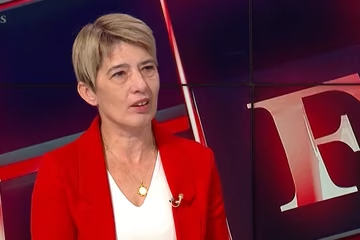
Berta López Domènech, an analyst at the European Policy Centre, emphasised the need to distinguish between eliminating unanimity at intermediate accession stages and broader Council reform. Removing unanimity during negotiating phases would reduce opportunities for individual states to leverage vetoes over bilateral disputes, such as historical friction between Bulgaria and North Macedonia or Croatia and Montenegro.
"Bilateralization of the accession process is one of the biggest disruptive factors affecting enlargement," López Domènech stated, noting that shifting to qualified majority voting when opening clusters or closing chapters would keep focus strictly on candidate performance. Unanimity would nevertheless remain mandatory for final accession decisions.
For Bosnia and Herzegovina, where domestic institutional paralysis has slowed progress, procedural changes in Brussels cannot substitute for required domestic reforms. While Bosnia was indicatively allocated up to €976.6 million in grants and concessional loans under the Growth Plan for the Western Balkans, initial disbursements remain pending agreement entries into force and condition fulfillment, unlike decisions already recorded for Albania, Montenegro, North Macedonia, and Serbia.
Beyond accession, the EU is considering post-entry safeguards to prevent democratic erosion, drawing lessons from post-accession rule-of-law challenges in Hungary and Poland. Proposals include temporary voting restrictions for new members in unanimity-driven areas and mechanisms allowing suspension of certain rights by qualified majority if fundamental values under Article 2 of the Treaty on European Union are breached.
López Domènech cautioned that any safeguards should apply strictly to rule violations to avoid establishing multi-tiered membership categories. She added that while internal debate signals renewed momentum, significant divisions remain among member states regarding voting rules and the timing of internal reforms relative to enlargement.
Kakvo je tvoje mišljenje o ovome?
Učestvuj u diskusiji ili pročitaj komentare


Kakvo je tvoje mišljenje o ovome?
Učestvuj u diskusiji ili pročitaj komentare