Srbija
 Hrvatska
 Slovenija

Thirty-one years on: The world remembers the victims of the Srebrenica genocide



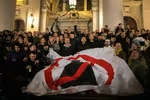
On 11 July, Bosnia and Herzegovina marks the 31st anniversary of the genocide in Srebrenica, the worst mass atrocity committed in Europe since the Second World War. Today, ten identified genocide victims will be laid to rest at the Potocari memorial centre alongside thousands of others.
This day is dedicated to remembering more than 8,000 Bosniak men and boys who were killed after the fall of the UN-declared safe area of Srebrenica in July 1995, as well as the thousands of families whose lives were permanently changed by the events.
Thirty years later, the search for victims - more than 900 of them, has not ended. Human remains continue to be identified through DNA analysis after being recovered from primary, secondary, and tertiary mass graves. This year 10 newly identified victims will be laid to rest at the Srebrenica–Potocari Memorial Centre alongside thousands already buried there.
The youngest victim to be buried today is 20, and the oldest 56 years old.
The genocide in Srebrenica has been established as a matter of international law. Two international courts - the International Criminal Tribunal for the former Yugoslavia (ICTY), the International Court of Justice (ICJ), and the Court of Bosnia and Herzegovina have all ruled that the crimes committed in July 1995 constituted genocide.
Among the most significant judgments are those against Radislav Krstic, the first person convicted in relation to the Srebrenica genocide, and former Bosnian Serb leaders Radovan Karadzic and Ratko Mladic, who were convicted of genocide, crimes against humanity, and war crimes. In 2007, the International Court of Justice confirmed that genocide had been committed in Srebrenica.
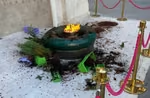
The Srebrenica–Potocari Memorial Centre has become the central place of remembrance for the victims and their families. Every year, thousands of people from Bosnia and Herzegovina and abroad gather there on 11 July to pay tribute to those killed and to attend the collective funeral for newly identified victims.
In May 2024, the United Nations General Assembly adopted a resolution designating 11 July as the International Day of Reflection and Commemoration of the 1995 Genocide in Srebrenica. The resolution encourages Member States to preserve the established historical facts, promote education about the genocide, and oppose genocide denial and the glorification of convicted war criminals.
Thirty years after the genocide, remembrance remains closely linked with justice and accountability. For survivors and victims' families, 11 July is not only a day of mourning, but also a reminder of the importance of preserving the historical record and ensuring that crimes of this scale are never forgotten.
Genocide denial and the glorification of convicted war criminals have been criminal offences in Bosnia and Herzegovina since 2021. In July of that year, then High Representative Valentin Inzko used his Bonn Powers to amend the country's Criminal Code, introducing penalties for the public approval, denial, gross trivialization or justification of genocide, crimes against humanity and war crimes established by final judgments of international or domestic courts, where such acts are likely to incite violence or hatred. The law also criminalizes the glorification of convicted war criminals, including the naming of public places or institutions in their honour. Depending on the offence, penalties range from six months to five years' imprisonment.
Kakvo je tvoje mišljenje o ovome?
Učestvuj u diskusiji ili pročitaj komentare


Kakvo je tvoje mišljenje o ovome?
Učestvuj u diskusiji ili pročitaj komentare