Srbija
 Hrvatska
 Slovenija

Bosnia's Becirovic at UN: RS leadership continues to threaten peace and security in country and region


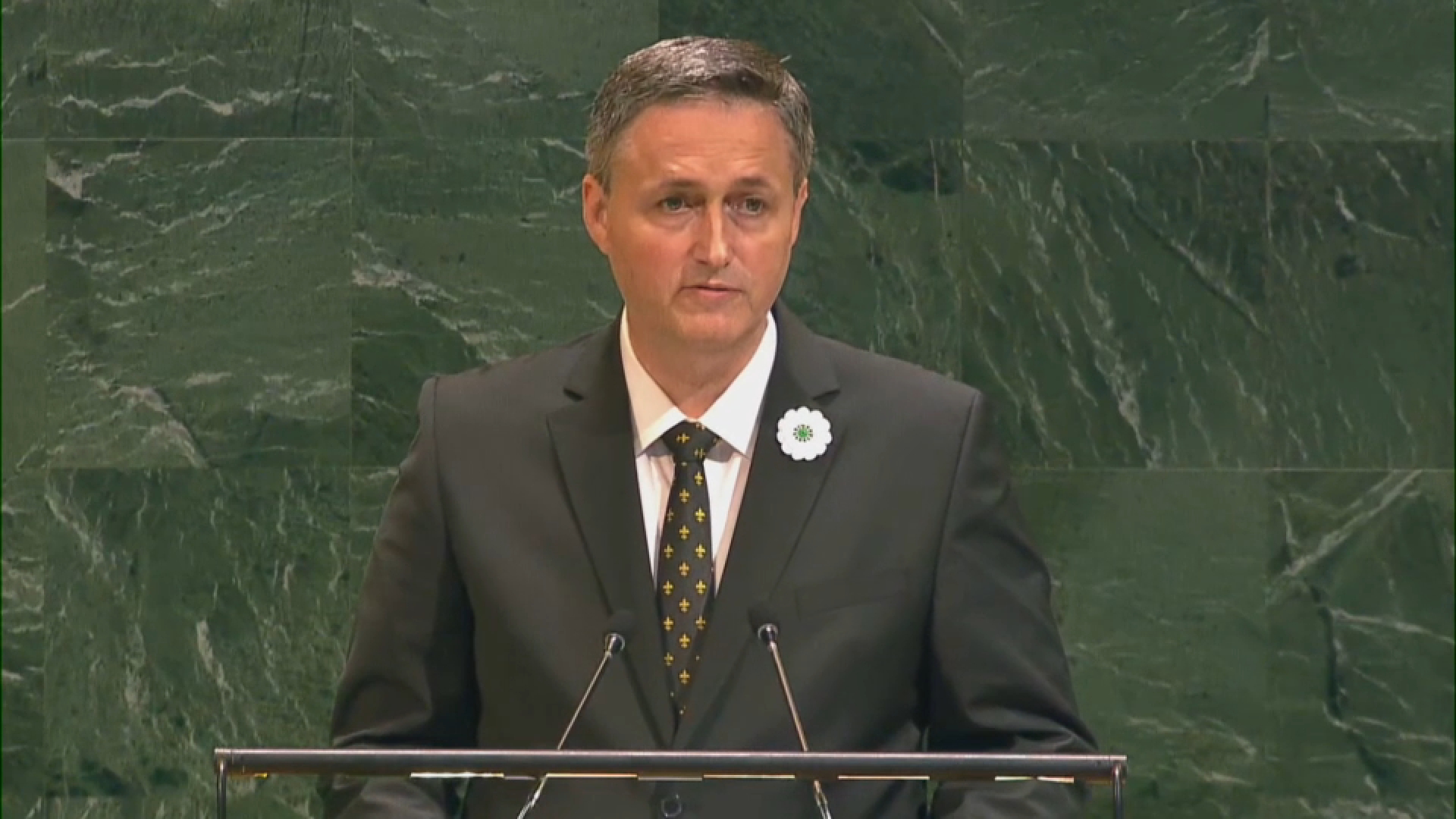
Chairman of the Presidency of Bosnia and Herzegovina Denis Becirovic warned the UN General Assembly that the current leadership of the Republika Srpska (RS) entity continues to threaten the peace and security of Bosnia and Herzegovina and the region, saying that efforts are being made to create conditions for the secession of the BiH entity.
Addressing the General Debate of the 81st session of the UN General Assembly in New York on behalf of Bosnia and Herzegovina, Becirovic said that the ideology and policies that led to the genocide against Bosniaks continue to pose a threat to Bosnia and Herzegovina.
"From the rostrum of the UN General Assembly, I want to publicly warn the international community that the current leadership of the BiH entity of Republika Srpska continues to threaten the peace and security of Bosnia and Herzegovina and the region. We must work together to stop such a destructive policy," Becirovic said.
He warned that, as he put it, those seeking to undermine the Dayton Peace Agreement are attempting to create conditions for the secession of Republika Srpska and that, in the coming period, they will intensify efforts aimed at weakening and abolishing the mandate of the international community's High Representative, weakening the institution of the Constitutional Court of Bosnia and Herzegovina and taking away state property belonging to Bosnia and Herzegovina.
Becirovic also highlighted the situation of genocide victims and employees of the Srebrenica Memorial Center, claiming that they have been subjected to unacceptable pressure from Republika Srpska police in recent months.
"We must not allow the police and other institutions of Republika Srpska that committed genocide against Bosniaks to intimidate survivors and those who preserve the memory of the victims of genocide today," he said.
Speaking about the position of Bosnia and Herzegovina more than three decades after the war, Becirovic said that from 1992 to 1995 the country was subjected to aggression, joint criminal enterprises, genocide against Bosniaks, crimes against humanity and other war crimes, while after the war, he said, destructive forces continued attempting to halt its progress through blockades and obstruction.
He stressed, however, that such actions can slow down but cannot stop Bosnia and Herzegovina's path towards becoming a modern European state.
"Today, Bosnia and Herzegovina stands at the doorstep of the European Union and the North Atlantic Treaty Organization (NATO). These are our strategic foreign policy goals, unanimously defined by the state authorities of Bosnia and Herzegovina," he said.
Becirovic said that actors still seek to pursue projects aimed at creating larger states at the expense of the territory of Bosnia and Herzegovina, noting that during the war they sought to achieve this by force of arms, while today they use political, diplomatic and other means.
In this context, he highlighted the importance of international court rulings, saying that UN courts had established the nature of the war waged against the Republic of Bosnia and Herzegovina.
He devoted a special part of his address to the genocide in Srebrenica, recalling that in May 2024 the UN General Assembly adopted a resolution declaring July 11 the International Day of Reflection and Commemoration of the 1995 Genocide in Srebrenica, describing it as a highly moral and civilizational act by the General Assembly.
He criticised Serbia's leadership for glorifying convicted war criminal Ratko Mladic, saying that the institutional glorification of war criminals is unacceptable and contrary to the values of the United Nations.
Becirovic also said that Serbia was the only state for which a UN court had established that it had violated its obligation under the Convention on the Prevention and Punishment of the Crime of Genocide, and called on the UN, the European Union and other international actors to clearly condemn and take concrete steps against those who institutionally glorify convicted war criminals.
Speaking about the broader international situation, Becirovic said the world was characterised by injustice, insecurity and intolerance, citing the rise of authoritarian populism, the aggression against Ukraine, the suffering in Gaza, the war in the Gulf region and the catastrophic situation in Sudan among the greatest challenges.
He said the world had not responded adequately to the aggression against Ukraine and, as he put it, the genocide against Palestinians in Gaza, just as it had failed to respond adequately during the aggression against Bosnia and Herzegovina.
According to him, the world's biggest crises have a common root - the erosion of international law.
Becirovic stressed that a policy of force cannot bring progress to humanity and that it must be replaced by respect for and strengthening of international norms, rules and institutions built over more than eight decades.
He warned that the multilateral system was facing a serious crisis of institutional trust, which was weakening because some actors in the international community were undermining the values enshrined in the UN Charter.
As a response to the existing challenges, he called for reaffirming the UN Charter, revitalising the role of the United Nations as a global centre for coordination and cooperation, supporting reforms and strengthening the UN's credibility, consistently implementing the Sustainable Development Goals, building mutual trust and inclusiveness, and strengthening preventive diplomacy.
He also called on UN member states to focus on interstate relations based on international law, respect for human rights and fundamental freedoms, the promotion of peace and social progress, and the fight against hate speech and all forms of discrimination.
He also identified strengthening policies to prevent genocide, crimes against humanity and other war crimes, advancing the rights of women and children, gender equality, and improving healthcare and education among the priorities.
"The world must return to the fundamental principles on which the UN is based: respect for human dignity, the sovereign equality of states, the peaceful settlement of disputes, and respect for international law," Becirovic said, adding that these were not unrealistic propositions but the foundations of a stable world.
He stressed that Bosnia and Herzegovina was a reliable and responsible UN member, aware of climate change and committed to contributing to global efforts in this area, as well as the transition to renewable energy sources and the reduction of harmful gas emissions. He added that BiH was also determined to combat all forms of terrorism.
Speaking about the importance of preserving peace, Becirovic said Bosnia and Herzegovina's experience showed that peace could not be taken for granted, but required the daily responsibility of political leaders, respect for rights and a readiness for dialogue.
"There must not be one standard for large states and another for small states. If we want to preserve confidence in the international order, the rules we establish together must be applied equally," he said.
At the end of his address, Becirovic said that Bosnia and Herzegovina was an unconquerable state, stressing that, according to him, there has not been a single map of Southeast Europe over the past 1,000 years on which Bosnia or Bosnia and Herzegovina does not appear.
Kakvo je tvoje mišljenje o ovome?
Učestvuj u diskusiji ili pročitaj komentare


Kakvo je tvoje mišljenje o ovome?
Učestvuj u diskusiji ili pročitaj komentare