Srbija
 Hrvatska
 Slovenija

Civil society representatives express concern over discussions on the new role of OHR


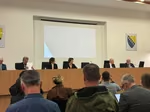
Representatives of civil society organizations from Bosnia and Herzegovina, members of the academic community, and an applicant before the European Court of Human Rights in Strasbourg, gathered around the Declaration on Constitutional and Other Reforms in Bosnia and Herzegovina on the path toward the EU and NATO, have expressed concern over discussions regarding the new role of the Office of the High Representative (OHR).
Following a panel discussion on the topic ''The New Positioning of the OHR and Bosnia and Herzegovina's Euro-Atlantic Perspective'', participants agreed on positions and conclusions, stating that significant differences had emerged during sessions of the United Nations Security Council and the Steering Board of the Peace Implementation Council (PIC) regarding the future and powers of the OHR.
Particularly concerning, according to the statement, are conceptual disagreements between the United States and European countries on these issues, as well as the lack of information on how these states view solutions to key matters, including state property.
Civil society representatives warned that Bosnia and Herzegovina could become collateral damage due to these disagreements and assessed that any delay in the appointment of a High Representative could lead to destabilization of the political situation in the country and the wider region.
The conclusions emphasized that Bosnia and Herzegovina still needs a strong role for the High Representative, including the use of the Bonn Powers when necessary, to help fulfill the requirements of the 5+2 agenda and create conditions for the closure of the OHR.
Panel participants assessed that, due to the actions of anti-state forces and separatist ambitions, the institutions of Bosnia and Herzegovina are dysfunctional and that the country’s progress on the Euro-Atlantic path has effectively stalled.
They also recalled that since 2009, when the first ruling of the European Court of Human Rights concerning Bosnia and Herzegovina's electoral system was issued, no progress has been made in implementing those rulings.
''It is difficult to expect these processes to continue without an appropriate role for the OHR,'' the conclusions stated.
It was announced that the agreed positions would be delivered to the leaders of political parties participating in executive and legislative authorities at the state level in Bosnia and Herzegovina, the Office of the High Representative, ambassadors of PIC member states, ambassadors of Croatia and Serbia, representatives of the EU Delegation and the Council of Europe in Bosnia and Herzegovina, as well as the media, according to a statement from the Council of Civil Society Organizations.
The positions were agreed upon by representatives of civil society organizations including the Council of the Congress of Bosniak Intellectuals, the Serb Civic Council – Movement for Equality, the Croat National Council, the Jewish Cultural and Humanitarian Society La Benevolencija, the Parliamentary Forum of Bosnia and Herzegovina 1990, the Center for Promotion of Civil Society, the Union for Sustainable Return in Bosnia and Herzegovina, the Academy of Sciences and Arts of Bosnia and Herzegovina, an applicant before the European Court of Human Rights, and members of the academic community.
Kakvo je tvoje mišljenje o ovome?
Učestvuj u diskusiji ili pročitaj komentare


Kakvo je tvoje mišljenje o ovome?
Učestvuj u diskusiji ili pročitaj komentare