Srbija
 Hrvatska
 Slovenija

Council of Ministers Chair: Delayed state budget already causing serious consequences


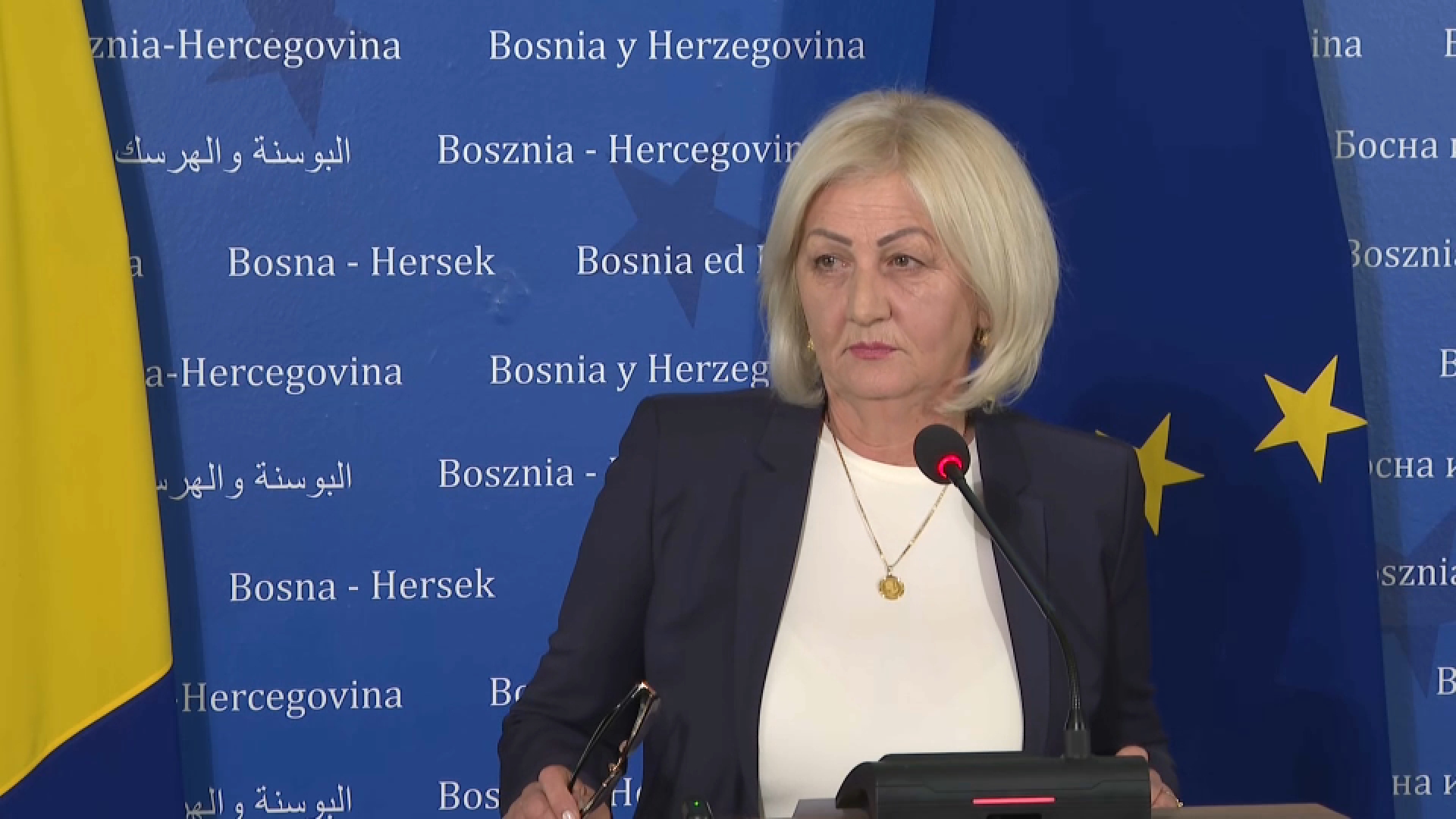
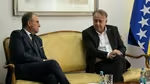
Bosnia and Herzegovina’s Council of Ministers Chair Borjana Kristo said after the government’s 115th session that the delay in adopting the 2026 state budget was already causing serious consequences for the functioning of institutions, capital projects and employee rights, while the issue of financing cultural institutions of national importance remains unresolved.
Speaking to reporters after the session, Kristo said the Council of Ministers had adopted the draft budget for BiH institutions and international obligations on May 21 and forwarded it to the Presidency of Bosnia and Herzegovina, which is the authorised proposer of the budget. However, she said the Presidency has still not sent the proposal to the state parliament.
“Almost two months have passed. We sent it to the Presidency, and to this day the proposal has not been forwarded to the Parliamentary Assembly of Bosnia and Herzegovina,” Kristo said.
She added that the Presidency had not formally informed the Council of Ministers of any proposed corrections or amendments, except for a letter sent to the Ministry of Finance and Treasury stating that the budget had not been adopted.
“That is, in my view, somewhat irresponsible, because they know what their legal obligations are. They can, of course, amend the budget proposal, because they are the authorised proposer,” Kristo said.
Kristo warned that the consequences of the delay were already visible. She recalled that a similar situation occurred last year, when significant funds remained unused and projects were left stalled because of the late adoption of the budget.
“Last year, a lot of funds remained unspent, and projects were standing still. The same is happening again with the 2026 budget,” she said.
She said the delay also affects civil servants and other state employees, particularly after earlier amendments to salary and allowance legislation.
“Employees and civil servants have the right to salary increases, and that should not be tied to the adoption of the budget. But we still do not have the budget, and those increases are not being paid regularly. The consequences are enormous, both for the functioning of institutions and for the rights of employees,” Kristo said.
She stressed that the Council of Ministers can only continue urging the Presidency to fulfil its constitutional and legal obligation.
“Until the budget is adopted by the Parliamentary Assembly, the responsibility is now on the Presidency, as the authorised proposer, to forward it,” Kristo said, adding that she hopes parliament will react quickly once the document arrives.
Cultural institutions still without a lasting solution
Kristo was also asked about the financing of cultural institutions of importance to Bosnia and Herzegovina, including whether the issue could be resolved through transfers, reserves or temporary mechanisms.
She said temporary solutions had been discussed before, but that a lasting answer requires a legal framework.
“I am sorry that, when it comes to cultural institutions of importance to Bosnia and Herzegovina, a law has still not been adopted. I think that is where the dispute lies. Once this is regulated properly and fairly by law, there would be a legal basis and we would not be discussing the issue in this way,” Kristo said.
She added that any temporary arrangement requires political consensus, which has not yet been reached.
“Everything depends on whether there is compromise. Unfortunately, at this moment, we have not reached it,” she said.
Decisions from the session
Kristo said the Council of Ministers approved 500,000 Bosnian marks from the current budget reserve to the City of Mostar to help address the consequences of the fire at the Uborak landfill.
The Council also approved the reallocation of unused funds previously intended for the Svilaj bridge. Kristo said around 2 to 2.5 million marks would now be redirected to the construction of a bridge over the Tara River toward Montenegro, a project she described as important for transport infrastructure between Bosnia and Herzegovina and Montenegro.
The Council also reopened tariff quotas for the import of raw sugar, approving a quota of 500,000 tonnes at a zero percent customs rate.
On the Southern Gas Interconnection project, Kristo said the Council of Ministers had completed its part by signing the initial agreement with Croatia. She said further agreements with contractors fall under the competence of the Federation entity government and the relevant ministry.
Asked about the appointment of a judge to the European Court of Human Rights in Strasbourg, Kristo said the Council of Ministers has no authority in that process, which is handled by the Presidency and the Council of Europe.
Foreign officials in BiH institutions
Kristo also commented on the role of foreign officials in institutions such as the Office of the High Representative and the Constitutional Court of Bosnia and Herzegovina.
“I personally believe that institutions can function without them. There is no one more interested in doing better work than those who live in this country and carry responsibility for all its peoples and citizens,” she said.
She added that, in her view, some decisions in the judiciary had caused Bosnia and Herzegovina “almost irreparable damage,” and that domestic institutions must take responsibility for the country’s future.
Kakvo je tvoje mišljenje o ovome?
Učestvuj u diskusiji ili pročitaj komentare


Kakvo je tvoje mišljenje o ovome?
Učestvuj u diskusiji ili pročitaj komentare