Srbija
 Hrvatska
 Slovenija

"Just asking questons?"
How Srebrenica Genocide denial learned to speak the language of debate


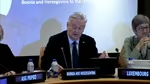
“It is hard to speak, and it is hard to live for 30 years, carrying the pain in your soul, while listening to genocide denial, glorification of war criminals.” Munira Subasic said that to the United Nations General Assembly in July 2025. She lost 22 members of her immediate family in the Srebrenica genocide - her husband, her youngest son and 20 others.
What she described was not just her own grief. It is a burden thousands of survivors across Bosnia and Herzegovina carry: more than 30 years on, remembering what happened is no longer the hardest part.
Defending that it happened at all is.

Bosnian Serb forces murdered more than 8,000 Bosniak men and boys after Srebrenica fell in July 1995. The killing was proven by international courts but that did not stop the denial. Instead, the denial evolved.
Holocaust scholar Deborah Lipstadt has spent much of her career studying exactly that transformation. Denial rarely stays still, she argues. As the historical record grows stronger, denial adapts. It rarely begins anymore with the blunt claim that nothing happened. Instead, it begins with questions.
Were the courts politically motivated? Were the death tolls inflated? Should there not be another commission? Why treat one interpretation of history as final? Why discourage debate?
Taken individually, those questions can sound like legitimate scepticism. Put together, critics argue, they serve a different purpose: dragging settled fact back into the territory of opinion.
And in the case of Srebrenica, that fact is about as settled as international law gets.
Over more than two decades, international courts examined witness testimony, military records, intercepted communications, forensic evidence, satellite imagery and thousands of exhibits.
In its landmark Krstic Appeals Judgment, the International Criminal Tribunal for the former Yugoslavia concluded that “the law condemns … the deep and lasting injury inflicted, and calls the massacre at Srebrenica by its proper name: genocide”.
The International Court of Justice later confirmed that the acts committed at Srebrenica constituted genocide. It also found that Serbia had violated its obligation to prevent the genocide and its obligations concerning the punishment of its perpetrators, although it did not hold the Serbian state directly responsible for committing the genocide.
So the defining question 30 years later is no longer whether genocide occurred. It is how denial survives once the historical and legal record has been settled.
Lipstadt argues that modern deniers increasingly seek legitimacy by adopting the appearance of academic inquiry. Rather than presenting themselves as extremists, they “camouflage their extremist and antisemitic agenda in the trappings of scientific investigation and scholarly discourse”, presenting themselves not as ideologues but as researchers searching for historical truth.
Over time, she observed, “the modus operandi of deniers has become increasingly subtle”. The goal is no longer necessarily to persuade people that an atrocity never happened. It is to create just enough uncertainty that established facts begin to look open to interpretation. That uncertainty often arrives disguised as debate.
“What is wrong with letting all ‘views’ be heard?” Lipstadt asks. Her answer is unequivocal. “This is a non-existent ‘debate’ in which only one side presents it as a debate: the deniers.”
The objective is no longer discovery. It is doubt.
And Bosnia and Herzegovina offers perhaps one of the clearest contemporary examples of how that strategy works in practice.
Scholarship or strategy?
Instead of outright rejection of the Srebrenica genocide, what increasingly emerges is almost exactly the pattern Lipstadt described: independent commissions, alternative investigations, competing experts and repeated calls to “reconsider” conclusions that international courts have already examined in extraordinary detail.
Perhaps the clearest example came in 2021, when the government of BiH's Republika Srpska entity established an “Independent International Commission” headed by Israeli Holocaust historian Gideon Greif.
Rather than presenting itself as a political initiative, the commission promised a fresh scientific reassessment of the events in and around Srebrenica. Its conclusions provoked immediate criticism from historians, genocide scholars and legal experts.
Among the most outspoken was Menachem Z. Rosensaft, Associate Executive Vice President and General Counsel of the World Jewish Congress and the son of two Holocaust survivors. He described the report as “an embarrassment to scholarship” that “flies in the face of the established record in international law.”
Rosensaft argued that the appointment of Greif was intended “to lend an aura of pseudo-scholarship” to what he described as another attempt to refute or whitewash crimes established before international courts. Rather than engaging with the overwhelming body of evidence, he wrote, the report “depicts as gospel the writings of largely discredited Srebrenica genocide deniers, without addressing the writings of historians and legal scholars who have reached diametrically different conclusions.”
Its final product, he concluded, was “essentially nothing more than an elaborate regurgitation of the decades-long Srebrenica genocide denial by Republika Srpska and Serb nationalist politicians, pseudo-academics, and others.”
Rosensaft’s criticism echoed Lipstadt almost point for point. The problem was not simply that the commission challenged established conclusions. It was that disagreement was presented as scholarship, creating the appearance of an unresolved academic controversy where decades of judicial findings had already established the historical record.
For the sake of fairness, the story did not end there. After the report attracted widespread international criticism - and after German President Frank-Walter Steinmeier decided not to proceed with plans to award him the Federal Cross of Merit - Greif acknowledged that his earlier public statements about the number of victims had been a mistake and said they would be corrected.
“This is the number that has been mentioned from the beginning onwards; it was never different: around 8,000. And we do not distort it; we accept it,” he said, adding that the commission would condemn the crimes more strongly in its clarification.
He did not, however, withdraw his rejection of the legal classification of genocide or the report’s broader conclusions. Nor was Greif’s commission an isolated case.
The Srebrenica Memorial Center’s 2022 report on genocide denial documented recurring methods used across the region to challenge the established historical record. These included disputing the number and identity of victims, promoting conspiracy theories that question the integrity of international courts, and engaging in nationalist historical revisionism.
The report also identified what it called a “pseudoscientific approach” in which supposed “counter-evidence” and “counter-arguments” are deployed to create the impression that the judicially established record remains fundamentally contested.
Its quantitative analysis recorded 693 acts of genocide denial between May 2021 and April 2022: 476 in Serbia and 176 in Bosnia and Herzegovina, 175 of them in Republika Srpska. It classified 444 cases as active denial, 126 as relativisation, 59 as support for perpetrators, 57 as recognition of a crime but not genocide, and five as calls for a new genocide.
Perhaps the report’s most important conclusion was that denial has changed. Rather than insisting that genocide never occurred, contemporary narratives increasingly seek to dissolve certainty itself - arguing that there are merely “different truths”, that history remains unsettled, or that international court judgments should be treated as only one interpretation among many.
Outright denial is relatively easy to recognise. Denial dressed in the language of scholarship, historical revision or “balanced debate” is far more difficult to identify. And that, Lipstadt warned years ago, is precisely the point.
The law meets denial
If denial has become more sophisticated, so too have efforts to confront it. In 2022, American scholar David Pettigrew urged German President Frank-Walter Steinmeier to reconsider plans to honour Greif, arguing that genocide denial is not simply another interpretation of history.
Drawing on the legal principles behind Bosnia and Herzegovina's criminalisation of genocide denial and the European Union's framework against Holocaust denial, Pettigrew wrote that denial "minimizes and trivializes the suffering of the targeted victims" and leaves them vulnerable to future violence. He concluded that "denial is a form of incitement to future violence against the group that was targeted."
That principle has increasingly been reflected in international policy. In 2024, the United Nations General Assembly adopted Resolution A/RES/78/282, designating 11 July as the International Day of Reflection and Commemoration of the 1995 Genocide in Srebrenica. The resolution also "condemns without reservation any denial of the Srebrenica genocide as a historical event" and urges Member States "to preserve the established facts, including through their educational systems, by developing appropriate programmes, also in remembrance, towards preventing denial and distortion, and the occurrence of genocides in the future."
Marking the first official UN commemoration in 2025, Secretary-General António Guterres warned: "After Srebrenica, the world said - once again - 'Never Again'. Yet hate speech is on the rise again... We see the glorification of war criminals. We see the same dangerous currents that once led to atrocity crimes. We cannot ignore these warning signs."
Evidence from Bosnia and Herzegovina suggests that confronting denial can influence public behaviour, even if it does not eliminate denial itself. Following former High Representative Valentin Inzko's 2021 amendments criminalising genocide denial and the glorification of convicted war criminals, BIRN BiH documented a sharp decline in denialist content on social media in the days immediately after the amendments entered into force.
The Srebrenica Memorial Center reached a similar conclusion in its broader annual analysis, documenting a significant reduction in recorded cases of denial within Bosnia and Herzegovina, even as similar narratives remained widespread elsewhere in the region.
The law did not end denial. It changed its vocabulary. That shift can also be seen in contemporary political rhetoric. In 2023, Nenad Nesic, who was BiH's Security Minister at the time, defended students who glorified convicted war criminal Ratko Mladic by arguing they had merely expressed "their opinions" and insisting that "an opinion cannot cause any pain."
Rather than openly rejecting the historical record, such arguments shift the discussion away from established judicial findings and toward questions of opinion, interpretation and freedom of expression - the very terrain Deborah Lipstadt identified as the contemporary language of denial.
The human cost of doubt
For survivors, however, there is nothing theoretical about that shift.
Returning to the United Nations three decades after the genocide, Munira Subasic reminded the world that the Mothers of Srebrenica "did not stop" and "did not wait for someone to bring them justice."
Near the end of her address, she explained what denial means to those still searching for their loved ones. "Without finding the bones of our children, we cannot say that they existed. Many are negating that we even had them."
The perpetrators first tried to conceal the crime physically, moving bodies from primary mass graves into secondary and tertiary graves in an effort to destroy the evidence.
It took decades of forensic work, DNA identification, witness testimony and judicial proceedings to reconstruct what had happened.
Today's struggle is different. Rather than concealing the crime itself, denial increasingly seeks to obscure the historical record through manufactured uncertainty, selective evidence, pseudo-scholarship and the appearance of legitimate debate.
Thirty years after Srebrenica, genocide denial rarely insists that the genocide never happened. Instead, it asks that history be debated all over again.
Kakvo je tvoje mišljenje o ovome?
Učestvuj u diskusiji ili pročitaj komentare


Kakvo je tvoje mišljenje o ovome?
Učestvuj u diskusiji ili pročitaj komentare