Srbija
 Hrvatska
 Slovenija

More than three decades since "Visegrad pyres", families still searching for remains


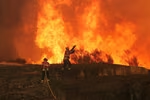
Families of victims and survivors will gather in Visegrad on Friday to mark 34 years since one of the most horrific crimes of the Bosnian war, when more than 70 Bosniak civilians were burned alive in a house in the Bikavac neighbourhood.
The victims, mostly women, children and elderly people, were forced into the house of Meho Aljic by members of a Serb paramilitary unit led by Milan Lukić, according to findings of the International Criminal Tribunal for the former Yugoslavia (ICTY).
The crime became known as the “living pyre”.
Bakira Hasecic, president of the Visegrad-based Women Victims of War association, said families are still waiting to bury their loved ones.
She recalled an exhumation carried out in 2016 at the site of Aljic’s house, when two or three burned bones were found near the pavement, but DNA analysis could not identify whom they belonged to.
“Unfortunately, not a single bone has been found to this day. Visegrad is silent, and I am deeply sorry because of that,” Hasečić said.
She said the absence of remains continues to cause pain for the families, as does the fact that only Milan Lukic has been convicted for the crime, although, according to survivors and victims’ associations, others involved are known and some still live in Visegrad.
Emza Fazlic of the Missing Persons Institute of Bosnia and Herzegovina told Detektor that 467 people are still being searched for in the Višegrad area, while 453 victims have been identified so far.
Only one person survived the Bikavac fire – Zehra Turjacanin, who later testified before the ICTY.
The Bikavac crime was committed just 13 days after another “living pyre” in Višegrad. On June 14, 1992, around 60 civilians from the Koritnik settlement were burned alive in the house of Adem Omeragic in Pionirska Street. The victims also included women, children, a newborn baby and elderly people.
The Hague tribunal sentenced Milan Lukic to life imprisonment for crimes committed in Višegrad, including the burnings in Pionirska Street and Bikavac.
The ICTY found that Serb forces forced civilians into Aljic’s house in Bikavac, fired shots inside, threw hand grenades into the house and then set it on fire.
Three decades later, families say justice remains incomplete as long as the remains of the victims are still missing and those who helped carry out the crime have not all been prosecuted.
Kakvo je tvoje mišljenje o ovome?
Učestvuj u diskusiji ili pročitaj komentare


Kakvo je tvoje mišljenje o ovome?
Učestvuj u diskusiji ili pročitaj komentare