Srbija
 Hrvatska
 Slovenija

Srebrenica survivors at UN: The world must carry responsibility


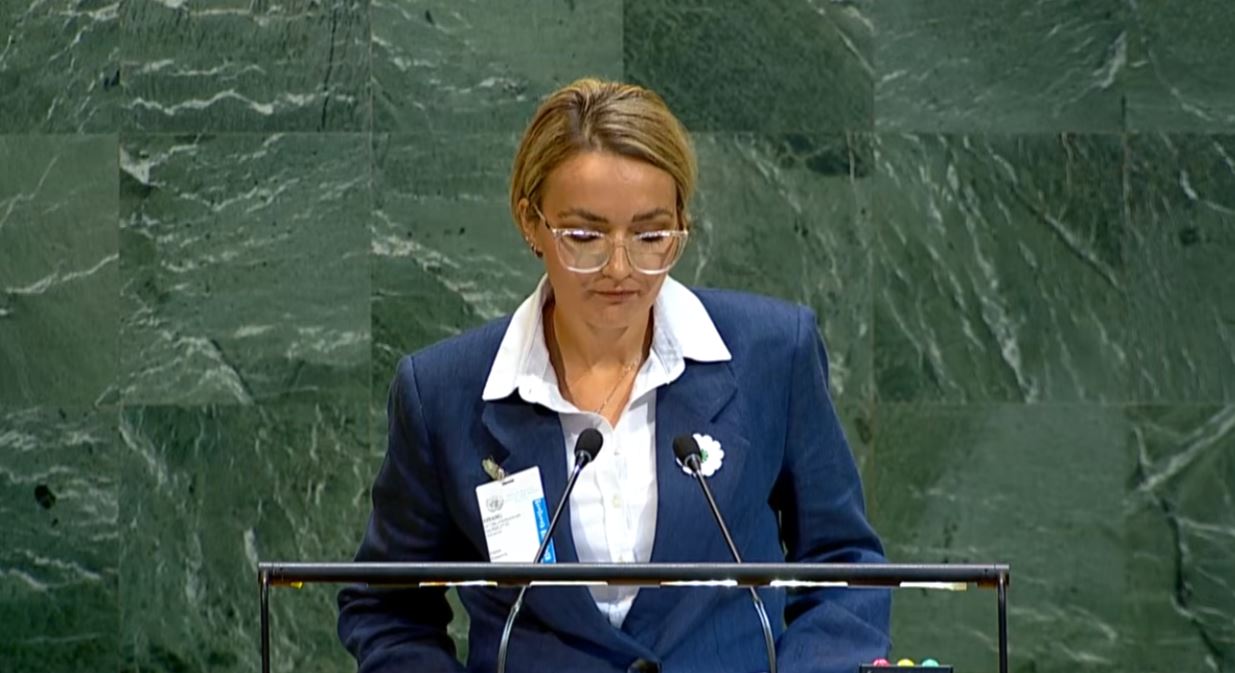
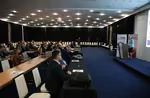
A cigarette box, a lost twin brother and a warning against denial framed the United Nations commemoration for the victims of the Srebrenica genocide, where survivors said remembrance must be followed by truth, accountability and action.
At the UN headquarters in New York, Emina Sinanovic, who survived Srebrenica as a child, said genocide had taken her father, grandfather and uncle, leaving behind questions no child should ever have to ask.

“I cannot remember the sound of my father’s voice. I cannot remember the warmth of his embrace,” she said, recalling the night she spent on the cold ground in Potocari, inside the UN base, surrounded by fear, crying women and confusion.
Her father Muriz was killed on July 13, 1995, in the Kravica warehouse, where thousands of Bosniak men and boys were executed. He was 32 years old. Before leaving for the forest, hoping to reach safety, he embraced his family and told Sinanovic’s mother: “Take care of the children.” Those were the last words she ever heard from him.
Years later, investigators found only a small object belonging to him near his remains in a secondary mass grave.
“Not his whole body. Not justice. Just a small cigarette box,” Sinanovic said. “That is all genocide left me.”
She said genocide does not end when the killing stops, because it steals futures, embraces, words and memories. Standing before the UN more than three decades later, she said she was no longer the frightened five-year-old girl who survived Srebrenica, but a woman carrying the voices of those who never had the chance to grow up.
Sinanovic warned that denial remains a continuation of the crime.
“Genocide denial is not a political position,” she said. “It is a systematic attempt to erase the truth.”
She also said the murder of her father was not only a family tragedy, but a failure of the international community to protect people in a UN-declared “safe area.”
“I am not asking the world to carry my pain. I am asking the world to carry responsibility,” she said.
Hasan Hasanovic, a survivor and representative of the Srebrenica Memorial Center, also addressed the commemoration, recalling how he was 19 when Srebrenica fell in July 1995.
Before the war, he said, he lived a simple life near Srebrenica with his twin brother Husein. Like many others, his family believed their future would be shaped by opportunity, not war. But after years under siege, hunger and shelling, they placed their hope in the UN safe area.
“We believed the world had not abandoned us,” Hasanovic said. “We were wrong.”
When the enclave fell, he joined the column of men and boys trying to reach free territory through the forests. His father and twin brother were with him. Within hours, they were separated.
“That was the last time I saw either of them alive,” he said.
Hasanovic survived days of ambushes, shelling, exhaustion, hunger and thirst. At one point, he said, he came within metres of Serb soldiers before turning and running.
“I survived. My father did not. My twin brother did not,” he said.
Years later, after their remains were found in mass graves, Hasanovic buried them with his own hands.
“No one should have to bury his twin brother. No son should have to bury his father after searching for his remains,” he said.
Today, Hasanovic leads the oral history programme at the Srebrenica Memorial Center, where testimonies of survivors are preserved as evidence against denial and forgetting.
“Denial is not only about the past. It is about the future,” he warned, adding that remembrance is not about being trapped in history, but about protecting future generations from hatred, dehumanisation and violence.
Chairman of the Presidency of Bosnia and Herzegovina Denis Becirovic also addressed the UN event, saying final judgments by international courts had confirmed that genocide was committed against Bosniaks in Srebrenica.
“These court decisions cannot be erased from the history of humanity,” Becirovic said, adding that Srebrenica was not a matter of statistics, but of “interrupted lives” of people and children who had hopes and dreams.
He described genocide denial as an “anti-civilisational act, an insult to the dead and a threat to the living,” stressing that July 11 must serve as a warning and a tool of prevention.
For survivors, the message from New York was clear: Srebrenica is not only Bosnia and Herzegovina’s story. It is a warning to the world about what happens when hatred becomes acceptable, when lies replace truth and when the international community turns away.
As Sinanovic concluded, remembrance is not only about the past, but a promise for the future - that truth will not be replaced by lies, and justice will not be replaced by indifference.
Kakvo je tvoje mišljenje o ovome?
Učestvuj u diskusiji ili pročitaj komentare


Kakvo je tvoje mišljenje o ovome?
Učestvuj u diskusiji ili pročitaj komentare