Srbija
 Hrvatska
 Slovenija

US congressional hearing exposes sharp divides over Balkans policy


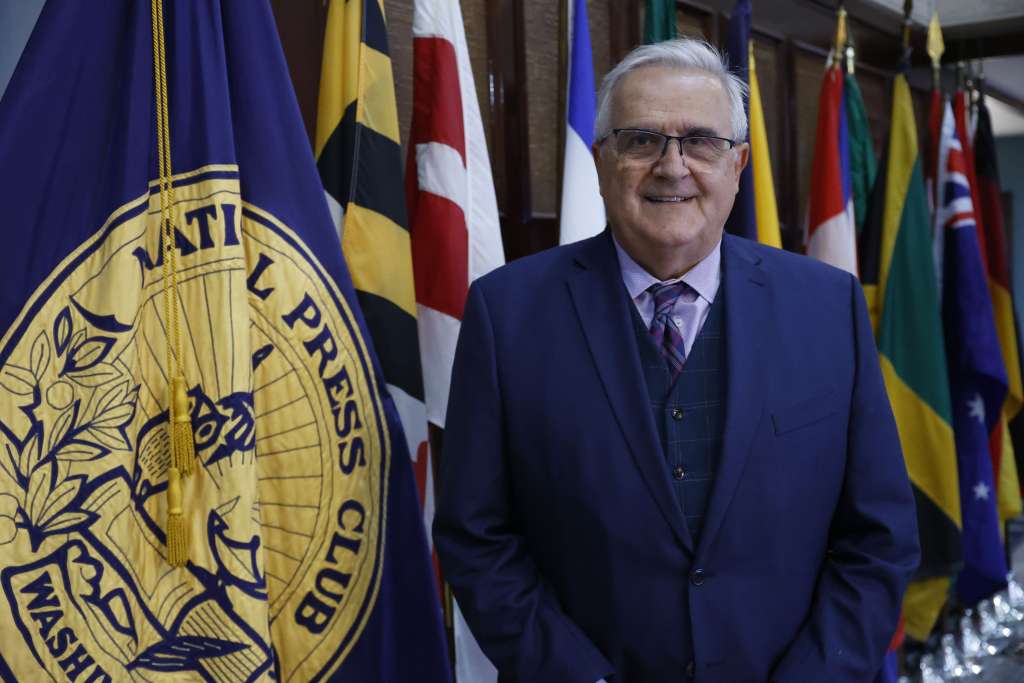
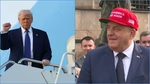
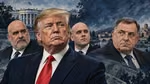
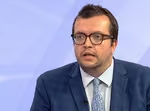
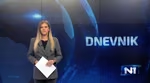
A hearing before the US House Foreign Affairs Committee has highlighted deep political fractures regarding American foreign policy towards Bosnia and Herzegovina and Serbia. Reporting from Washington, Federation (FBiH) entity Television correspondent Ivica Puljic noted that the proceedings revealed significant disagreements between the legislative branch and the executive administration, particularly concerning the lifting of sanctions on Bosnian Serb leader Milorad Dodik.
During the hearing, State Department official Daniel Lawton defended the administration's policy, claiming that US diplomacy had resolved a long-standing crisis last year and that lifting sanctions against Dodik served to stabilize the region. However, Puljic described this assertion as detached from reality, pointing to a counter-document released by committee Democrats and supported by two Republicans.
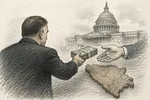
The congressional report asserts that lifting sanctions on Dodik and supporting the private firm AAFS Infrastructure & Energy in building the Southern Interconnection gas pipeline directly harms Bosnia's interests and violates the Dayton Peace Agreement. Lawmakers expressed concern that the administration might exert economic pressure linked to the energy project to resolve the sensitive issue of state property in favour of entity ownership over state control. Consequently, lawmakers demanded the reinstatement of sanctions against Dodik, an investigation into AAFS, and an end to federal support for the company's involvement.
Despite internal policy divisions, Puljic emphasized that the State Department reaffirmed a core principle, stating that the US continues to support the territorial integrity and sovereignty of Bosnia and Herzegovina. Nevertheless, he observed that Washington has clearly designated Serbia as its primary strategic partner in the Balkans, pointing to high-level investments and joint NATO military exercises, despite concerns over Belgrade's procurement of Chinese weapons and Russian influence.
Concerns were also raised regarding Serbia's political trajectory. Republican Congressman Joe Wilson warned that upcoming elections in Serbia might not be free and fair, noting proposed legislation that could suspend the bilateral strategic dialogue unless Russian influence is curtailed.
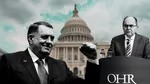
When questioned about the funeral of convicted war criminal Ratko Mladic and Serbia's official response, State Department representatives asserted under pressure that the US rejects the glorification of war criminals and recognizes the Srebrenica genocide, though they declined to publicly condemn Belgrade's actions directly. Regarding international oversight, the US remains opposed to immediately closing the Office of the High Representative (OHR) in Bosnia, while supporting the continuation of NATO's KFOR mission in Kosovo and monitoring the upcoming UN Security Council vote on EUFOR's mandate.
Kakvo je tvoje mišljenje o ovome?
Učestvuj u diskusiji ili pročitaj komentare


Kakvo je tvoje mišljenje o ovome?
Učestvuj u diskusiji ili pročitaj komentare