Srbija
 Hrvatska
 Slovenija

Womble: Bosnia and Herzegovina is strongest when it embraces both its roots and its global reach


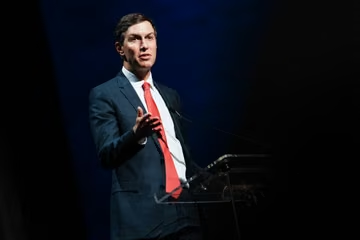
The Head of Mission of the International Organization for Migration (IOM) in Bosnia and Herzegovina, with coordination functions for the Western Balkans at IOM, David Womble, stated that public discussions about migration often focus on inciting fear, division, or a sense of loss.
"Yet for Bosnia and Herzegovina, migration has also been a source of resilience, opportunity, and national pride. At a moment when the country faces demographic decline, labour shortages, and increasing competition for economic growth, it is important to speak honestly about migration not only as a challenge to manage, but as a force that can help build a stronger future," Womble wrote in an Op-Ed reflecting on the Bosnia and Herzegovina diaspora, the phenomenon of BiH football, and the national team's qualification for the FIFA World Cup in the United States.
He noted that Bosnia and Herzegovina has long been a country shaped by movement, both inward and outward. Millions of Bosnians and Herzegovinian have built lives abroad in Europe, North America, and beyond. They left seeking safety, opportunity, education, or employment, but they never stopped contributing to their homeland. Through remittances, investment, skills, knowledge, and enduring family ties, the Bosnian and Herzegovinian diaspora has helped sustain communities across the country for decades.
Womble underlined that the Bosnian and Herzegovinian diaspora represents one of the country’s greatest assets. Bosnians and Herzegovinians abroad have become successful entrepreneurs, engineers, doctors, academics, artists, and workers in every sector imaginable. Their achievements are a reminder that migration, when safe, orderly, and regular, benefits not only destination countries, but also countries of origin. Migration has allowed generations of Bosnians and Herzegovinians to pursue dignity and prosperity while carrying their identity and culture proudly across the world.
"At the same time, Bosnia and Herzegovina itself increasingly needs labour migration to sustain economic growth. Across sectors ranging from construction and tourism to health care, transport, information technology, and manufacturing, employers are struggling to fill vacancies. Many young people continue to leave, while the working-age population declines. These realities are not unique to Bosnia and Herzegovina; they are being felt across much of Europe.
The answer is not to fear migration, but to manage it wisely and humanely. Countries that embrace well-regulated labour mobility are often better positioned to grow their economies, support innovation, and maintain essential public services. Labour migration can help businesses expand, strengthen competitiveness, and create opportunities for local workers alongside newcomers. When migrants are welcomed, protected, and integrated into society, everyone benefits," said Womble.
He added that migration has always been part of the human story. It connects societies, spreads ideas, and enriches cultures. Bosnia and Herzegovina understands this perhaps better than many nations because migration is deeply woven into its own history. The experience of Bosnians and Herzegovinians abroad demonstrates that people can successfully integrate into new societies while maintaining profound loyalty and love for their homeland.
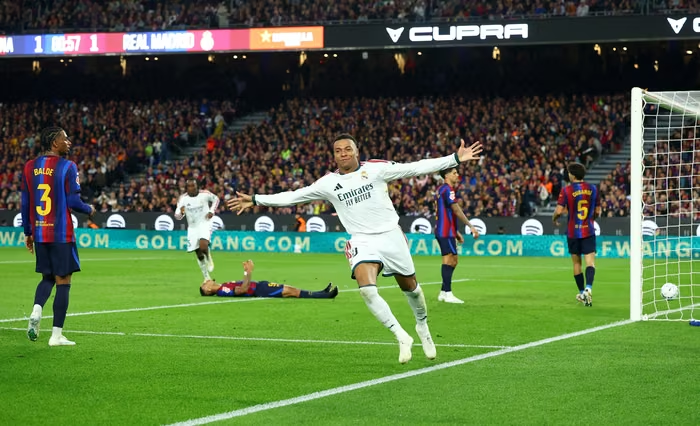
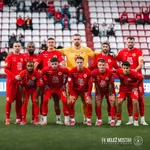
"Nowhere is this more visible than in sport. As Bosnia and Herzegovina’s national football team embarks on an exciting World Cup journey, we are reminded how migration can strengthen national identity rather than weaken it. Many of the team’s most celebrated players developed their talents abroad — in Germany, Austria, Sweden, Switzerland, and elsewhere — benefiting from international experience, professional training, and global competition. Yet they never forgot where they came from. Powered by ćevapi and spirit, they are wearing the Bosnian and Herzegovinian jersey with pride and inspire millions at home and across the diaspora," he noted.
Womble understands that the success of Bosnian and Herzegovinian football reflects the success of Bosnians and Herzegovinians everywhere: connected to the world, enriched by international experience, yet deeply rooted in their homeland. It is proof that migration and patriotism are not opposites. They can, in fact, reinforce one another.
Noting that as the national team prepares for World Cup group play in North America, Bosnians and Herzegovinians across Sarajevo, Tuzla, Mostar, Banja Luka, Chicago, Toronto, Vienna, Stockholm, and countless other cities will cheer together as one people. That global connection is something to celebrate.
"Migration has helped shape modern Bosnia and Herzegovina. If managed with vision, humanity, and cooperation, it can also help shape a more prosperous future.
And as we rally behind the Dragons on the road to the World Cup, may their journey remind us all that Bosnia and Herzegovina is strongest when it embraces both its roots and its global reach. Naprijed, Zmajevi!" wrote in his Op-Ed David Womble, Chief of Mission of the International Organization for Migration (IOM) in Bosnia and Herzegovina and IOM Coordinator for the Western Balkans.
Kakvo je tvoje mišljenje o ovome?
Učestvuj u diskusiji ili pročitaj komentare


Kakvo je tvoje mišljenje o ovome?
Učestvuj u diskusiji ili pročitaj komentare