Srbija
 Hrvatska
 Slovenija

Wildfires continue across Bosnia and Herzegovina as minefields hamper firefighting efforts


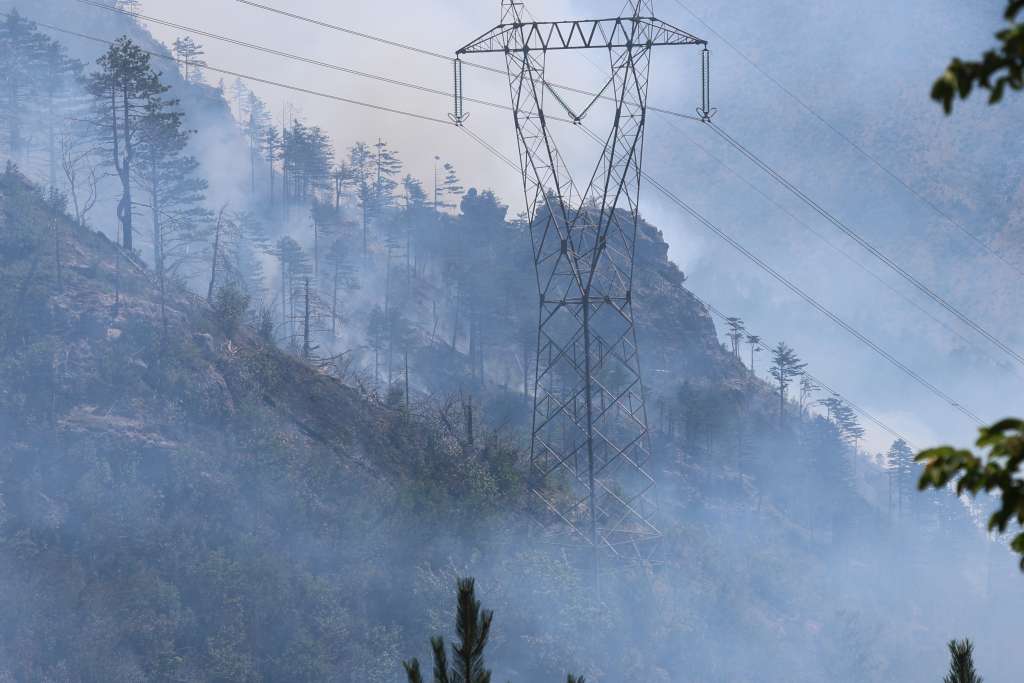
Wildfires continued to burn across southern Bosnia and Herzegovina on Sunday, with firefighters battling multiple active blazes in the Rujiste area near Mostar and the Rakitnica River canyon near Konjic. Authorities warn that unexploded landmines, difficult terrain, high temperatures and shifting winds are significantly complicating firefighting operations.
Pero Pavlovic, spokesperson for the Civil Protection Administration of the Herzegovina-Neretva Canton, told N1 that the situation remains serious, although no residential or commercial properties are currently under direct threat.
Firefighters at Rujiste have managed to contain the fire in areas they can safely access. However, the blaze has spread into terrain believed to be contaminated with landmines, making ground operations impossible. Air Tractor firefighting aircraft are expected to resume operations in the morning in an effort to prevent the fire from reaching the popular Rujiste picnic area.
Pavlović said there have been no casualties or damage to homes or business facilities in the Rujiste area so far, although aerial firefighting is also complicated by power lines crossing the affected zone.
Fire near Konjic advancing toward Dubovci
The wildfire burning in the Rakitnica River canyon near Konjic also remains active and has spread into extremely inaccessible terrain.
According to Pavlovic, the fire is moving toward the village of Dubovci, raising concerns that it could eventually reach populated areas.
For that reason, a helicopter from the Armed Forces of Bosnia and Herzegovina was scheduled to assist firefighting efforts on Sunday morning in an attempt to stop the fire's advance.
Authorities said there is a nearby water source suitable for helicopter operations, which should improve the efficiency of aerial firefighting. At this stage, no homes or commercial buildings are endangered, although several hunting lodges are located in the area.
No evacuation planned
Civil Protection officials said there are currently no plans to evacuate residents.
"If there were a need for evacuation, colleagues in Konjic and Mostar would already have informed the Operational Civil Protection Centre and the public," Pavlovic said, adding that while the situation is not good, it is not yet critical in terms of immediate danger to residential or commercial buildings.
He warned that high temperatures and constantly changing winds are expected to make firefighting particularly challenging.
Human activity remains the leading cause
Pavlovic said statistics continue to show that human activity is responsible for most wildfires in Herzegovina.
Although thunderstorms and lightning strikes have caused some fires over the past two weeks, he described those incidents as isolated compared to the number of fires caused by human negligence each year.
As an example, he recalled seeing passengers throw cigarette butts from a moving vehicle while driving from Prozor-Rama toward Mostar the previous evening.
He urged citizens to behave more responsibly in nature, stressing that firefighters spend much of the summer battling wildfires almost continuously.
Calls for tougher penalties
Pavlovic argued that stricter penalties and a more efficient judicial system would help discourage irresponsible behaviour.
He said those responsible for starting fires are sometimes identified, but legal proceedings often take years and end without a clear outcome.
He also warned that wildfires destroy forests, threaten wildlife, worsen air quality and increase the risk of landslides in burned areas.
Even unintentional mistakes can trigger devastating fires, he added, citing discarded glass left in nature, poorly extinguished campfires and sparks from railway lines or power infrastructure where vegetation has not been properly cleared.
Progress made, but more Investment needed
According to Pavlović, the Herzegovina-Neretva Canton has significantly improved its firefighting capabilities in recent years.
Fire departments now operate modern vehicles, two Air Tractor aircraft are available, and almost the entire canton is covered by a video surveillance system that enables rapid fire detection and quicker emergency response.
Regarding aerial firefighting, Pavlović said the decision to refill the Air Tractor aircraft in Sarajevo rather than Mostar was based on operational assessments that it would be safer and more efficient for missions around Konjic.
He stressed that Bosnia and Herzegovina must invest more seriously in aerial firefighting assets and simplify procedures for deploying them.
"The procurement of serious firefighting aircraft should be among the priorities at every level of government. Progress has been made regarding procedures for deploying Armed Forces helicopters and Air Tractor aircraft, but much more remains to be done if we are to establish an effective wildfire response system. Otherwise, I fear all that will remain behind us will be scorched land," Pavlovic said.
Fire stabilized near Drvar, but threat moves toward Una-Sana Canton
Meanwhile, after burning for four days, the wildfire near the village of Kamenica in the municipality of Drvar has been stabilized, according to Civil Protection officials from Canton 10.
Marino Vidovic told FENA that favourable weather conditions helped firefighters bring the blaze under control after it reached access roads, where its spread was halted.
However, the fire has now moved toward the border area with the Una-Sana Canton, prompting Canton 10's Operational Centre to notify authorities there as the wildfire develops on their territory. Additional firefighting units remain on standby.
As in Herzegovina, mine-suspected terrain severely complicated operations around Drvar. Firefighters, forestry workers and emergency services were unable to safely access the affected areas.
Vidovic explained that standard safety procedures prohibit helicopters and other aircraft from operating directly above mine-contaminated terrain because the detonation of unexploded ordnance could endanger both the aircraft and its crew. For that reason, a helicopter from the Armed Forces of Bosnia and Herzegovina was not deployed to the Drvar fire.
The Government of Canton 10 also discussed the possibility of deploying Air Tractor aircraft. However, officials concluded that aerial firefighting alone has limited effectiveness when ground crews cannot safely reach the fire.
"Regardless of how much an Air Tractor can do, if people cannot reach the fire on the ground, there is only so much that can be achieved," Canton 10 Prime Minister Ivan Vukadin said.
Kakvo je tvoje mišljenje o ovome?
Učestvuj u diskusiji ili pročitaj komentare


Kakvo je tvoje mišljenje o ovome?
Učestvuj u diskusiji ili pročitaj komentare