Srbija
 Hrvatska
 Slovenija

A new position and a new strategy: Is Brussels rethinking its role in the Western Balkans?


While diplomatic circles are increasingly discussing the selection of a new High Representative for Bosnia and Herzegovina following Christian Schmidt’s resignation, as well as disagreements within the Peace Implementation Council over his successor, the European Commission has made a move that was followed in Bosnia and Herzegovina only as an agency news item.
However, regional experts are raising a question: does the appointment of Marko Makovec as the European Commission’s Chief Adviser for Reconciliation and Normalisation in the Western Balkans signal that Brussels is entering a new phase of political engagement towards the region?
At first glance, this appears to be another personnel appointment within European institutions. However, the fact that the European Commission has, for the first time, established a position dedicated exclusively to reconciliation and the normalisation of relations suggests that these issues are gaining a significantly more important place in the enlargement policy than before.
The European Union’s existing criteria remain essential: the rule of law, judicial reforms, the fight against corruption and economic reforms continue to form the foundation of the enlargement process. However, in recent years Brussels has increasingly insisted on political stability, regional cooperation and good-neighbourly relations, especially after Russia’s invasion of Ukraine returned the security of the European continent and the prevention of Russian and other external influences to the centre of political priorities.
This is precisely one of the contexts in which Marko Makovec’s appointment can be interpreted.
More than a personnel appointment
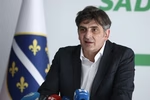
Political analyst Adi Cerimagic believes that Makovec’s selection is not a surprise, given his extensive experience in European diplomacy and his strong knowledge of the region.
"Marko Makovec is an experienced Slovenian and European diplomat. He was an adviser to the President of Slovenia, worked for a long time in the European External Action Service, and over the last year he was the head of cabinet of European Commissioner for Enlargement Marta Kos. He is someone who knows Brussels, the Western Balkan countries and political actors in the region very well," Ćerimagić said in an interview with N1.
According to him, the establishment of this position is likely also linked to the growing need for the European Union to be more present and more concrete in addressing political challenges in the Western Balkans.
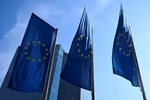
"I think that, apart from his professional step, one of the reasons is also pressure on the European Union to show more, to be more proactive and to help resolve concrete problems. It is difficult to say precisely, he should in the coming period be responsible for special tasks within enlargement policy, regarding the normalisation of relations between countries or within countries such as Bosnia and Herzegovina, and reconciliation," Cerimagic said.
He adds that it is enough to look at the political rhetoric in the region to understand why the European Union wants to devote more attention to this area.
Who is Marko Makovec?
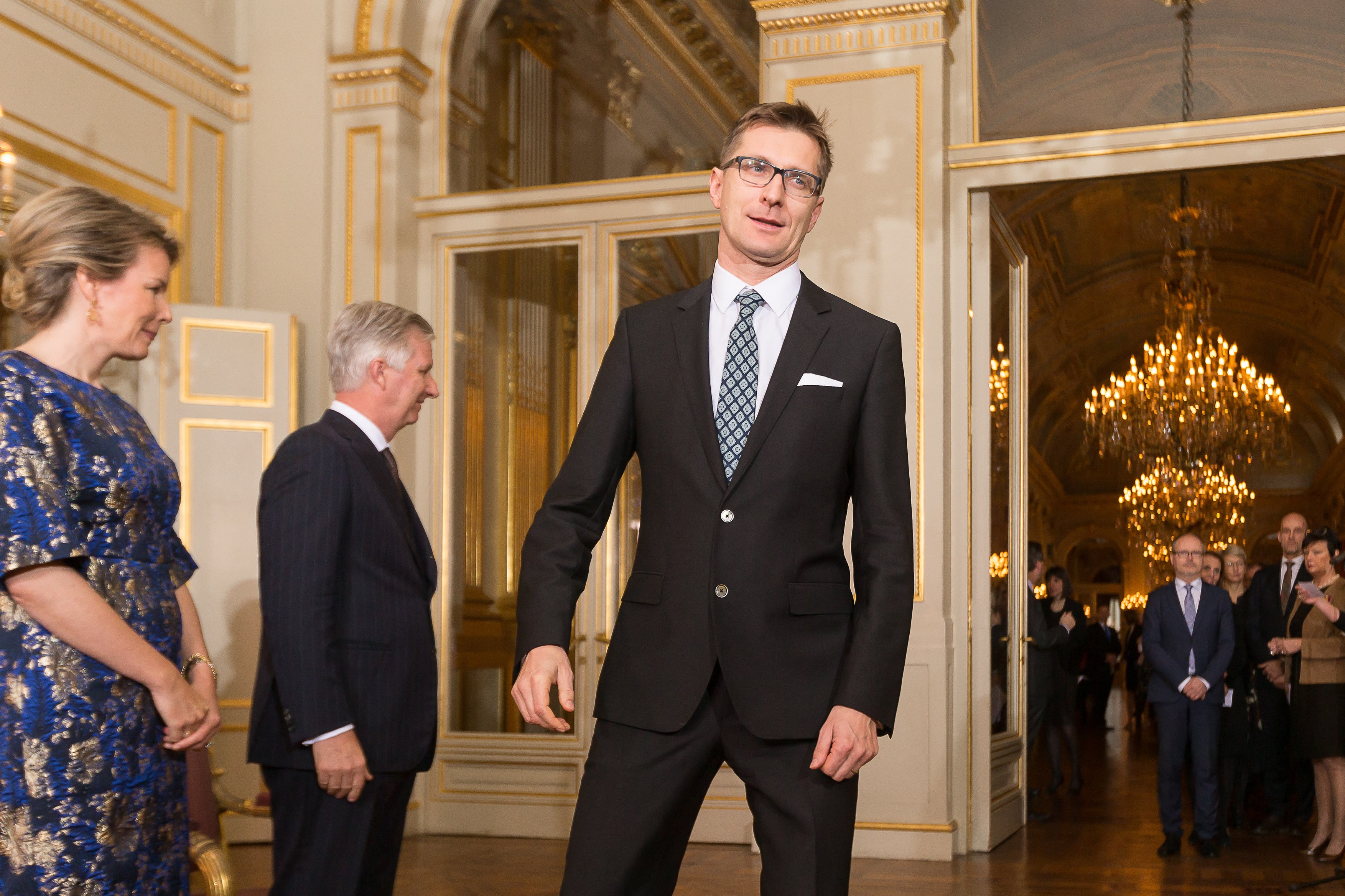
The new position has been given to Slovenian diplomat and lawyer Marko Makovec, who specialises in international law.
Throughout his career, he served as a chief foreign policy adviser to the President and Prime Minister of Slovenia, ambassador and Slovenia’s representative to the European Union’s Political and Security Committee, deputy head of mission at the Slovenian Embassy in Rome, and since 2020 has served as director and deputy managing director for Europe at the European External Action Service (EEAS).
He speaks English, French, Italian and Croatian, and a significant part of his professional career has been dedicated precisely to issues concerning the Western Balkans and European foreign policy.
Although he will not have executive powers or a mandate similar to that of European Union Special Representatives, his role will be to advise the European Commission on issues of reconciliation, regional cooperation and the normalisation of relations — areas that Brussels increasingly links with the enlargement policy.
What does this mean for the Region?
The new position itself will not change relations in the Western Balkans, nor will Makovec mediate in every political dispute. However, its establishment shows that the European Commission wants to have a person who will systematically deal with issues that have remained in the background for years, although they have often slowed down the European path of countries in the region.
Although Brussels has not provided an official explanation following the creation of this position, for Bosnia and Herzegovina it could mean greater focus by the European Commission on political dialogue, the functioning of institutions and internal stability.
At the regional level, attention could remain focused on relations between Western Balkan countries and issues that have burdened the European integration process for years.

Makovec’s appointment coincides with discussions about the future of international engagement in Bosnia and Herzegovina. Following Christian Schmidt’s resignation, negotiations over his successor have been unsuccessfully ongoing for months, with different views among some European Union member states and the United States regarding who should take over the role of the person overseeing the civilian component of the peace implementation process in the country.
Whether the new position will bring concrete results remains to be seen. However, the European Commission’s decision to dedicate a specific position to reconciliation and normalisation of relations for the first time indicates that Brussels increasingly views the region not only through the fulfilment of technical conditions for membership.
At a time of growing geopolitical challenges, the European Union clearly assesses that the stability of the Western Balkans is no longer only a matter of enlargement, but also a matter of its own security. For this reason, it wants to have a more active political role in addressing problems that have burdened the region for years.
Kakvo je tvoje mišljenje o ovome?
Učestvuj u diskusiji ili pročitaj komentare


Kakvo je tvoje mišljenje o ovome?
Učestvuj u diskusiji ili pročitaj komentare