Srbija
 Hrvatska
 Slovenija

Fmr. High Rep. Valentin Inzko urges PIC to retain OHR and Bonn powers


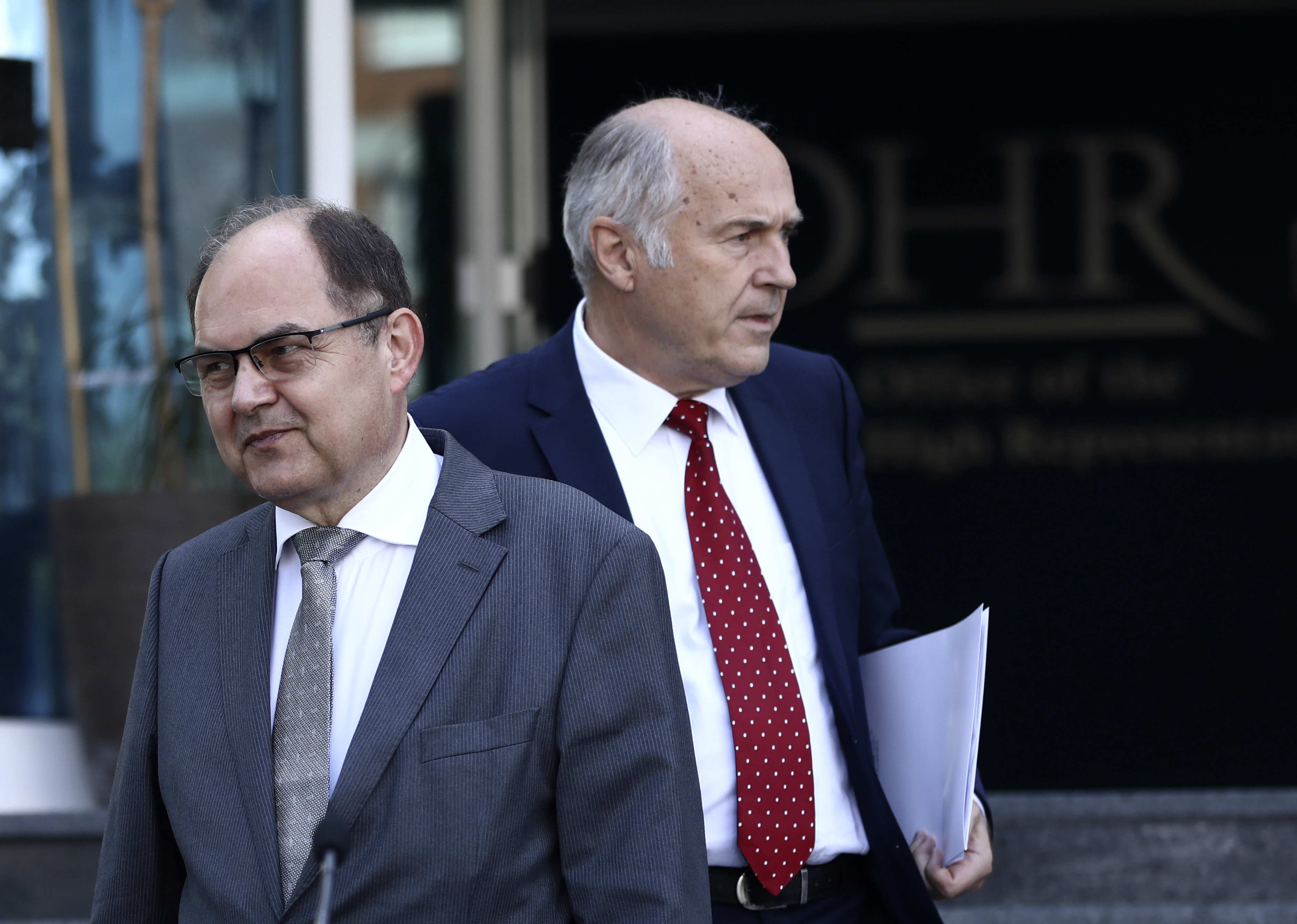
The two-day session of the Steering Board of the Peace Implementation Council (PIC), which is expected to decide on the appointment of a new High Representative in Bosnia and Herzegovina, begins on Wednesday in Sarajevo. Ahead of the session, former High Representative Valentin Inzko addressed the members of the PIC in an open letter.
Inzko began his address with the folk proverb "Measure three times, cut once," stating that this exact thought reminded him of media reports regarding negotiations being conducted on the future of the Office of the High Representative (OHR) and the Bonn powers.
"I sincerely ask all political actors who decide on the future of the OHR today to measure at least five times before they cut a precious tool that has helped resolve problems and prevent conflicts in this suffering country countless times in the past," Inzko stated.
OHR is not an obstacle to the European path
Reminding that since his departure from office nearly five years ago he has mostly refrained from public statements so as not to influence the work of his successor and the PIC, Inzko emphasizes that today he feels a moral, political, and human obligation to react to claims that the OHR represents an obstacle to the European integration of Bosnia and Herzegovina.
Based on his twelve years of experience in the position of High Representative, he claims that the OHR is not a brake on the path toward the European Union, but could rather, if a need arose for it, contribute to the acceleration of that process.
"The presence of the High Representative bothers those who conduct destructive policies because he can, in the final instance, use the Bonn powers to overcome blockades in the work of state institutions," he said.
According to him, domestic political leaders have had numerous opportunities over the years to reach compromises and show the ability to assume responsibility for processes in the country, but agreements were frequently absent due to ultimatums and policies leading toward secession.
As an example, he cited the fact that Bosnia and Herzegovina even today does not have the text of a state anthem, but only a melody, because no agreement was reached even on content that would describe the natural beauties of the country. He also recalled the multi-year contestation of introducing the unique European emergency number 112, as well as six unsuccessful attempts to adopt a law that would ban genocide denial, the downplaying of war crimes, and the glorification of convicted war criminals.
Bonn powers as a last resort
Inzko states that during his mandate he always gave preference to domestic agreements and that the PIC member states also advocated for the use of Bonn powers exclusively as a last resort.
Nevertheless, he recalled that in the final weeks of his mandate he reached for those powers to ban genocide denial and the glorification of war criminals.
"I was deeply aware that such occurrences are the seed of a new war in that country. Furthermore, my conscience did not allow me to act otherwise," he stated.
He added that agreements on numerous issues were not possible and that for certain topics, not even a minimal framework for conversation existed. As an example, he cited the adoption of the budget in the final moments at the end of the year, as well as the fact that certain questions were removed from the agenda in advance.
State property and warning of consequences
He specifically looked back at the issue of state property, emphasizing that for years there has been no willingness to discuss this topic by the authorities of Republika Srpska.
"If someone refuses any discussion on state property, as the President of Republika Srpska Milorad Dodik has been doing for years, then it is clear that an agreement cannot be reached nor a domestic law adopted that would resolve this complex issue," he stated.
Inzko believes that Dodik and his political partners seek to remove the High Representative and the Bonn powers so that, due to the inability of the institutions to function, the dissolution of the state occurs.
"It is clear that such a process could not pass without at least a limited conflict, if not a serious war," he warned.
He also pointed to what he claims are lobbying activities advocating for the removal of international mechanisms that preserve the Dayton order, among which are the OHR, the Bonn powers, and the presence of EUFOR. In his opinion, such moves lead to the weakening of the state and open the path toward the independence of Republika Srpska.
Appeal to the international community
Because of everything stated, Inzko forwarded an appeal to the international community to carefully consider all consequences of potential decisions that could alter the existing framework of the international presence in Bosnia and Herzegovina.
He recalled the results achieved after Dayton, including the formation of unified armed forces, the Ministry of Defence, common passports, unique license plates, and the border police.
He posed the question of whether a potential abandonment of existing mechanisms would mean rewarding secessionist policies three decades after major efforts invested in building peace.
"Of course the three peoples and all citizens of this country can live together. I am convinced of that," he stated.
At the same time, he warned that secession would mean a message that genocide and war crimes pay off, while the victims and the entirety of humanity would be the losers.
Call to retain all instruments
Reflecting again on the issue of state property, Inzko asked whether the international community wants to reward a person who, according to him, has already refused discussion on that topic for 15 years and meanwhile presents the situation to investors as if the issue is resolved.
In the end, he called upon the members of the Peace Implementation Council to seriously look at all facts before making decisions.
"Bosnia and Herzegovina, once a successful story and the pride of the international community, is currently on a path toward catastrophe," he warned.
He concluded that the OHR must retain all available instruments of action, including the Bonn powers.
"Even if the OHR does not use them, they must remain available. Otherwise, the OHR would reduce itself to just another non-governmental organization that expresses concern from time to time," Inzko stated.
Kakvo je tvoje mišljenje o ovome?
Učestvuj u diskusiji ili pročitaj komentare


Kakvo je tvoje mišljenje o ovome?
Učestvuj u diskusiji ili pročitaj komentare