Srbija
 Hrvatska
 Slovenija

Croatian PM defends multilateralism over rule of force at UN General Assembly


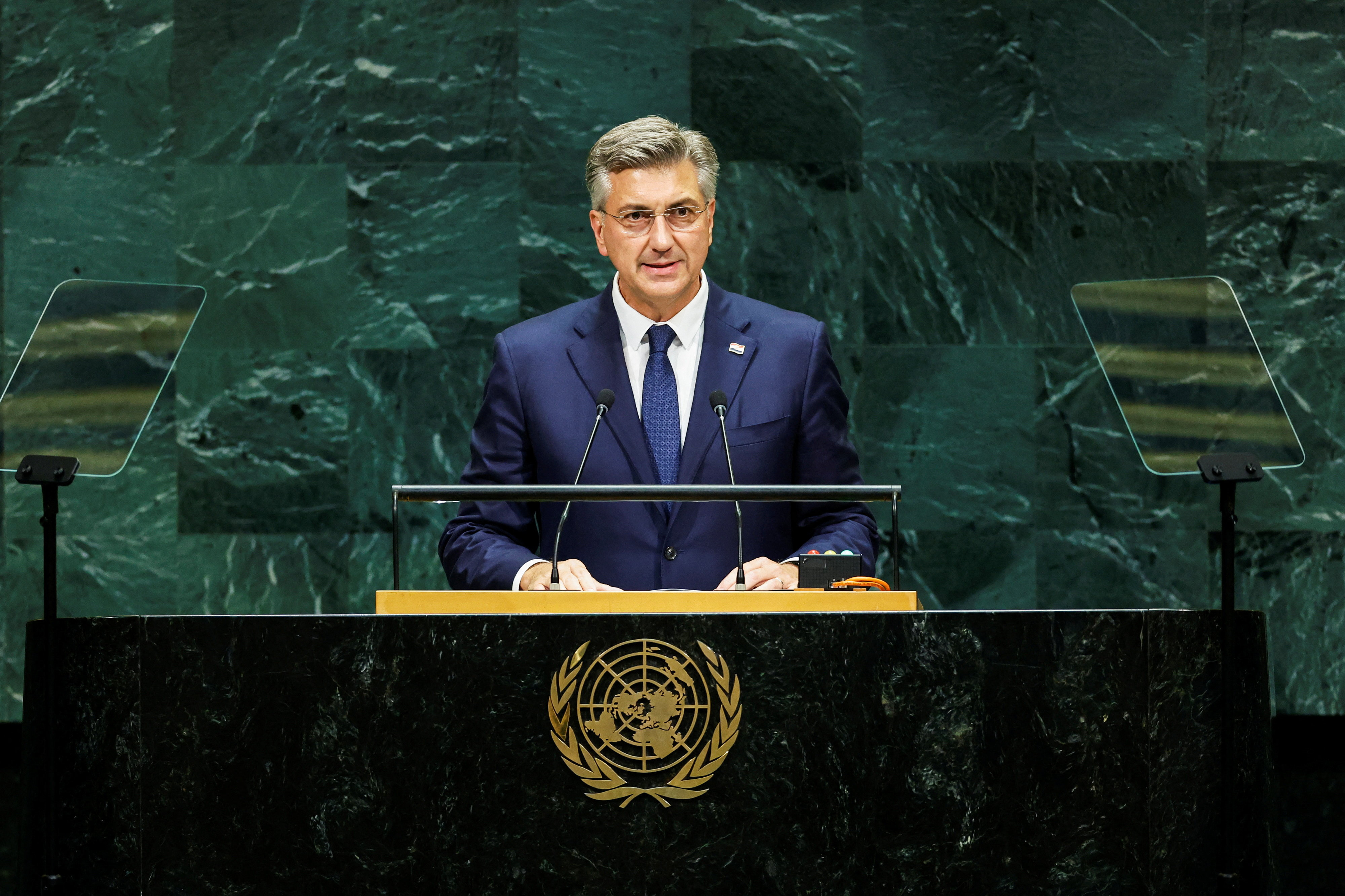
"International law is the line between order and tyranny," Prime Minister Andrej Plenković said in his address to the UN General Assembly on Tuesday, calling for renewed trust in multilateralism that delivers results.
Croatia supports "rules-based multilateralism as the pinnacle of human cooperation not because we are naive, but because we have seen and experienced the alternative," the Croatian PM said in his speech before the United Nations General Assembly in New York.
"The answer is therefore not less multilateralism. It is multilateralism that delivers."
Plenkovic spoke about Croatia's path as a country that experienced aggression, defended itself and rebuilt, before developing its democracy and integrating into international organisations.
"For smaller and medium-sized states, international law is not an abstraction. It is the line between order and tyranny, between sovereign equality and the rule of force."
"The rule of force such as witnessed by Croatia during the brutal aggression and occupation of more than one quarter of our territory in the 1990s. In the war which claimed nearly 20,000 lives," he recalls.
"And after which, more than three decades later, Croatia continues to search for 1,725 missing persons - a poignant example that the consequences of war do not end when the weapons fall silent."
"Instead, peace requires courage, credible institutions, and rules that apply equally to everyone," the Croatian PM said.
"Russia's ongoing war of aggression against Ukraine is a direct assault on those rules," Plenkovic said adding that "Croatia will continue to support Ukraine's sovereignty, independence, and territorial integrity, and a comprehensive, just, and lasting peace based on the UN Charter."
"Peace cannot reward conquest, and recovery cannot be separated from justice," he underscored.
The same compass must guide us in the Middle East, said
"Protection of civilians, unhindered humanitarian access, respect for international law, and a credible political horizon are essential to breaking the cycle of violence. Croatia supports a negotiated two-state solution in which Israelis and Palestinians will live in peace and security."
The need for reform
In his address, Plenkovic said the world was changing under the influence of technology, climate change, demographic pressures, irregular migration and geopolitical rivalry. In this context, the United Nations must also transform, the prime minister said.
"Croatia supports a UN that is more effective, accountable, and financially sustainable, and stronger across all three pillars: peace and security, sustainable development, and, of course, human rights," the Croatian PM said.
"Reform must also produce a more representative and effective Security Council. When the Council is blocked, the General Assembly can and must act, but it cannot replace the Council's primary responsibility under the Charter. This makes the selection of the next Secretary-General all the more relevant," Plenkovic said and thanked Secretary General Antonio Guterres for his work over the last decade.
The Portuguese diplomat's second term ends at the end of this year, with discussions under way over his successor. Seven candidates are in the running, and under the UN's informal regional rotation system, the organisation's leadership could pass to a candidate from Latin America. Some analysts predict that the UN could appoint its first woman to the post.
Challenges facing the world
In his address, Plenkovic stressed that artificial intelligence could accelerate development, but that its use must remain within legal frameworks and respect human dignity and democratic accountability.
Renewed nuclear rhetoric makes a firm commitment to the Treaty on the Non-Proliferation of Nuclear Weapons more important than ever, while climate action should be harnessed to strengthen energy security and social cohesion, the prime minister added.
"Our experience shows that the green transition should not be ideological. It can endure only when it is technologically realistic, socially fair, compatible with secure and affordable energy, and supportive of overall development."
"For Europe, which imports most of the energy it consumes, the case for producing more renewable energy at home now reaches far beyond climate policy," he added.
Concerning the topic of illegal migration, Plenkovic said that irregular migration "has caused mistrust in Europe and altered the political landscape in many countries."
"This situation is unacceptable and it cannot continue. The rule of law must be upheld, and legal procedures must be followed. Our primary responsibility is to our citizens."
Mladic's funeral in Belgrade is an affront to his victims
At the General Assembly, Plenkovic also touched on EU enlargement, saying that south-east Europe remains an unfinished part of the European project.
"Croatia will continue to support merit-based EU enlargement. EU membership can turn borders of division into lines of cooperation, and reforms on paper into stronger institutions and better living standards."
"But European transformation requires honesty about the past. Reconciliation becomes possible when responsibility for the crimes of the past is acknowledged and their glorification rejected."
"That standard allows no national exceptions," he said referring to the funeral of Serbian general Ratko Mladic, convicted of genocide and other war crimes committed in Bosnia and Herzegovina.
"That means respect for victims and clear rejection of historical revisionism - not the glorification of war criminals. Ratko Mladic was a convicted war criminal responsible for the Srebrenica genocide - the first genocide in Europe since the Holocaust," Plenkovic recalled.
"While his criminal record reached its nefarious culmination in Srebrenica, his trail of war crimes stretches further back—to the shelling of Croatian cities, the murder of civilians, the mining of dams, and the destruction of cultural heritage and industrial facilities," the Croatian PM said in his address to the UN the General Assembly.
"The military and official honors accorded to Mladic in Serbia were an affront to his victims and to the judgments of international courts. The participation of state representatives and the public acclaim that accompanied the ceremony is totally incompatible with the values of a Union Serbia seeks to join."
The same commitment to equality and reform should guide Bosnia and Herzegovina, Plenkovic added.
Kakvo je tvoje mišljenje o ovome?
Učestvuj u diskusiji ili pročitaj komentare


Kakvo je tvoje mišljenje o ovome?
Učestvuj u diskusiji ili pročitaj komentare