Srbija
 Hrvatska
 Slovenija

Lifting of sanctions against Dodik can mean new US approach towards BiH


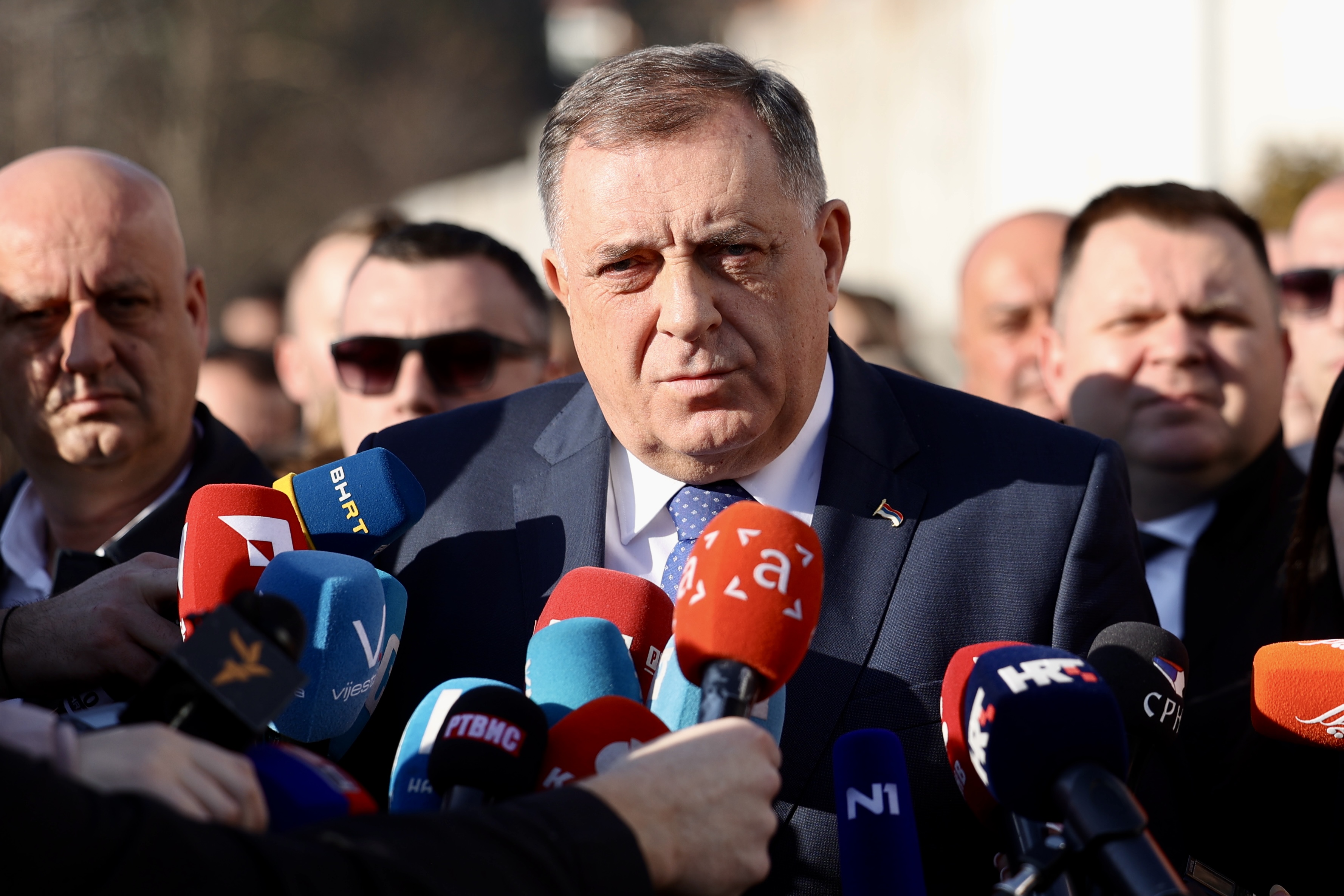
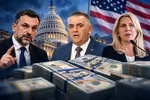
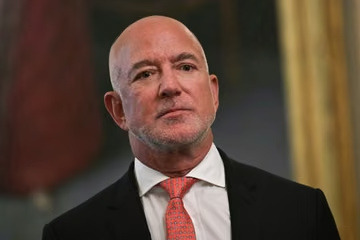
The removal of US sanctions against Milorad Dodik and around thirty of his associates and close family members is being interpreted by politicians, analysts and media outlets in Bosnia and Herzegovina as confirmation that the current Trump administration is testing a new approach towards BiH.
The Office of Foreign Assets Control (OFAC), part of the US Department of the Treasury, announced on Wednesday that Dodik, Zeljka Cvijanovic, a member of the Presidency of Bosnia and Herzegovina, some twenty current and former officials of Bosnia and Herzegovina and Republika Srpska, as well as a number of companies previously placed on the US blacklist for allegedly being part of a corrupt network supporting Dodik’s rule and personal enrichment, have all been removed from the sanctions list.
OFAC did not explain why Dodik, his associates and the companies are no longer subject to punitive measures, which had included a travel ban to the United States and the freezing of any assets held on US territory.
The US State Department later clarified that the move was part of the regular annual reviews carried out to promote American interests. However, it also confirmed that the lifting of sanctions was directly linked to Dodik’s resignation as President of Republika Srpska and the abolishment of controversial laws previously adopted by the entity’s parliament at his initiative.
The constructive actions taken by the Republika Srpska National Assembly in recent weeks should enhance the stability of Bosnia and Herzegovina and will enable a partnership with the United States based on shared interests, economic potential and mutual prosperity, the State Department said in a statement provided to the portal Detektor.ba.
It added that they plan to work closely with political actors and stakeholders “from across the political spectrum in Bosnia and Herzegovina” to advance shared priorities. However, it remains unclear why some individuals from the Serb Democratic Party (SDS), as well as HDZ’s Marinko Cavara, the Speaker of the House of Representatives of the Parliamentary Assembly of BiH, remain on the sanctions list. Cavara had been sanctioned for allegedly blocking the appointment of judges to the Constitutional Court of the Federation of BiH during his tenure as the entity’s president. As a result, Cavara has been unable to receive his salary for months.
Dodik was first placed under US sanctions in 2017, which remained in effect during Donald Trump's first term.
The Biden administration later expanded the measures, targeting a broader circle of Dodik's close associates and enablers of his separatist rhetoric and actions.
Sinisa Karan, Dodik’s current candidate in the upcoming snap elections for President of Republika Srpska, was sanctioned for his role as RS Minister of the Interior, where he directly helped draft legislation aimed at separating the entity from Bosnia and Herzegovina.
Although media outlets in Republika Srpska controlled by the authorities have reported ecstatically on the lifting of sanctions, portraying it as Dodik's crowning victory, he himself responded with restraint, expressing gratitude to Trump for his understanding.
The opposition in Republika Srpska immediately interpreted the lifting of sanctions as proof that Dodik had "sold everything out" for his own personal benefit.
The key test of the effectiveness of the new approach by the US administration will be how Dodik's Alliance of Independent Social Democrats (SNSD), which formally remains part of the ruling coalition in Bosnia and Herzegovina, behaves when it comes to adopting the state budget and passing two key laws required for the country to open accession negotiations with the European Union.
An important issue will also be the appointment of the chief negotiator, with Dodik's adviser Ana Trisic Babic, currently the acting President of Republika Srpska, being mentioned as the most likely candidate.
The Bosniak-civic parties within the ruling coalition have firmly rejected the possibility of her being appointed as chief negotiator, though they agree that the position should be held by a Serb.
Kakvo je tvoje mišljenje o ovome?
Učestvuj u diskusiji ili pročitaj komentare


Kakvo je tvoje mišljenje o ovome?
Učestvuj u diskusiji ili pročitaj komentare