Srbija
 Hrvatska
 Slovenija

Schmidt: OHR still plays an important role in preserving Bosnia’s functionality


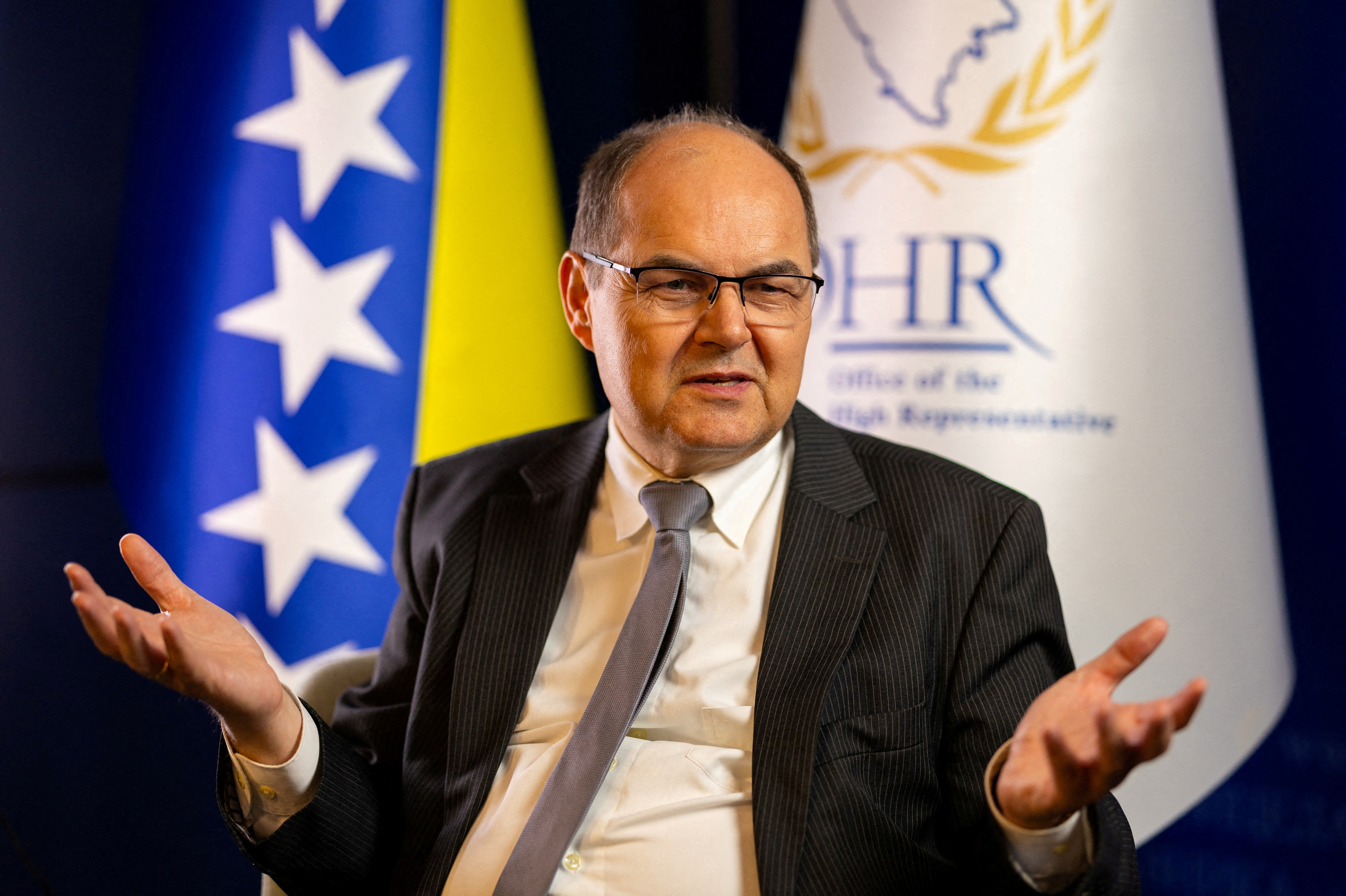
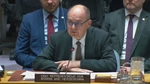
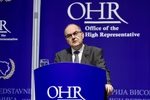
Christian Schmidt told the Frankfurter Allgemeine Zeitung (FAZ) that he made the decision to step down as High Representative in Bosnia and Herzegovina after "intensive but successful talks" with the United States, rejecting claims that he was forced to step down, while at the same time warning of the strengthening of separatist policies in Bosnia and Herzegovina.
International peace envoy told German media that his departure from Bosnia and Herzegovina was not the result of coercion, but rather a personal decision made after “intense but successful” talks aimed at preventing political disagreements from damaging the Office of the High Representative. Reflecting on his five-year mandate, the second longest among all High Representatives in Bosnia, Schmidt stressed that Bosnia’s problems will not disappear simply because one person leaves and another arrives.
Speaking about transatlantic relations, Schmidt agreed with Angela Merkel’s famous statement that Europe can no longer fully rely on the United States, but questioned what Europe itself has done to build an independent strategy. He argued that the EU has failed to act decisively in Bosnia, particularly regarding the country’s energy dependence on Russian gas. According to Schmidt, Europe initially strongly supported the idea of a gas pipeline from Croatia to Bosnia, but later withdrew support because the project was not based on renewable energy, leaving Bosnia dependent on Russian supplies while the United States stepped in to push the project forward.

Russian influence and separatism
Schmidt also warned about growing Russian influence and separatist ambitions in Bosnia and Herzegovina. He referred to a lobbying contract signed by Republika Srpska entity with the Israeli-Canadian firm Dickens & Madson, which explicitly stated that Republika Srpska’s independence and Schmidt’s removal were key goals. Schmidt described the contract as a serious warning sign of a coordinated effort directed both against Bosnia and against his own office. He emphasized that Republika Srpska’s independence would directly violate the Dayton Peace Agreement and contradict the official position of the United States, which has repeatedly reaffirmed support for Bosnia and Herzegovina’s territorial integrity.
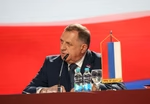
Although one of the contract’s objectives - Schmidt’s departure, has now been achieved, he avoided directly discussing Milorad Dodik personally, arguing that too much focus is placed on one individual instead of the broader problems of nepotism, lack of transparency, and semi-authoritarian tendencies within Republika Srpska. Schmidt nevertheless expressed concern about increasingly close ties between Dodik and figures associated with the MAGA movement in the United States, including Donald Trump Jr.’s planned visit to Banja Luka. He warned that any attempt to redraw borders in the Balkans would create new instability rather than solve existing problems.
Responding to criticism that the Office of the High Representative lacks real power, Schmidt insisted that the institution still plays an important role in preserving Bosnia’s functionality. He argued that if the state itself were seriously threatened, diplomatic and military mechanisms of the international community would have to be activated. Schmidt pointed to concrete achievements during his mandate, including ensuring that future elections are conducted according to OSCE principles and introducing biometric voter identification measures.
At the same time, Schmidt acknowledged that the Dayton Peace Agreement effectively created what he described as a “qualified ceasefire.” Referring to Clausewitz’s famous definition of war as politics by other means, Schmidt said that in Bosnia one could instead speak of politics as the continuation of war by other means. He rejected claims that the High Representatives had failed over the past 25 years, insisting that Bosnia’s current functionality exists largely because of international interventions, although he admitted that long-term stability can only come through European integration and genuine political consensus within Bosnia and Herzegovina.
Schmidt further addressed the unresolved issue of Bosnian state property, particularly in relation to the planned America-backed gas pipeline. He said the Constitutional Court of Bosnia and Herzegovina has repeatedly confirmed the existence of state property, but political actors continue to deny it, preventing legislation from being adopted. According to Schmidt, the United States at least managed to create momentum around the issue.
Finally, Schmidt expressed deep concern over the rise of Islamophobic rhetoric in Bosnia and Herzegovina. He said hate speech directed at Bosnian Muslims has become increasingly open and normalized, including the derogatory use of the word “Turk.” Schmidt warned that such rhetoric fuels fears of renewed conflict and represents one of the most troubling political developments in the country today.
Kakvo je tvoje mišljenje o ovome?
Učestvuj u diskusiji ili pročitaj komentare


Kakvo je tvoje mišljenje o ovome?
Učestvuj u diskusiji ili pročitaj komentare