Srbija
 Hrvatska
 Slovenija

Schmidt warns UN of “ongoing deconstruction” of Bosnia’s institutional order


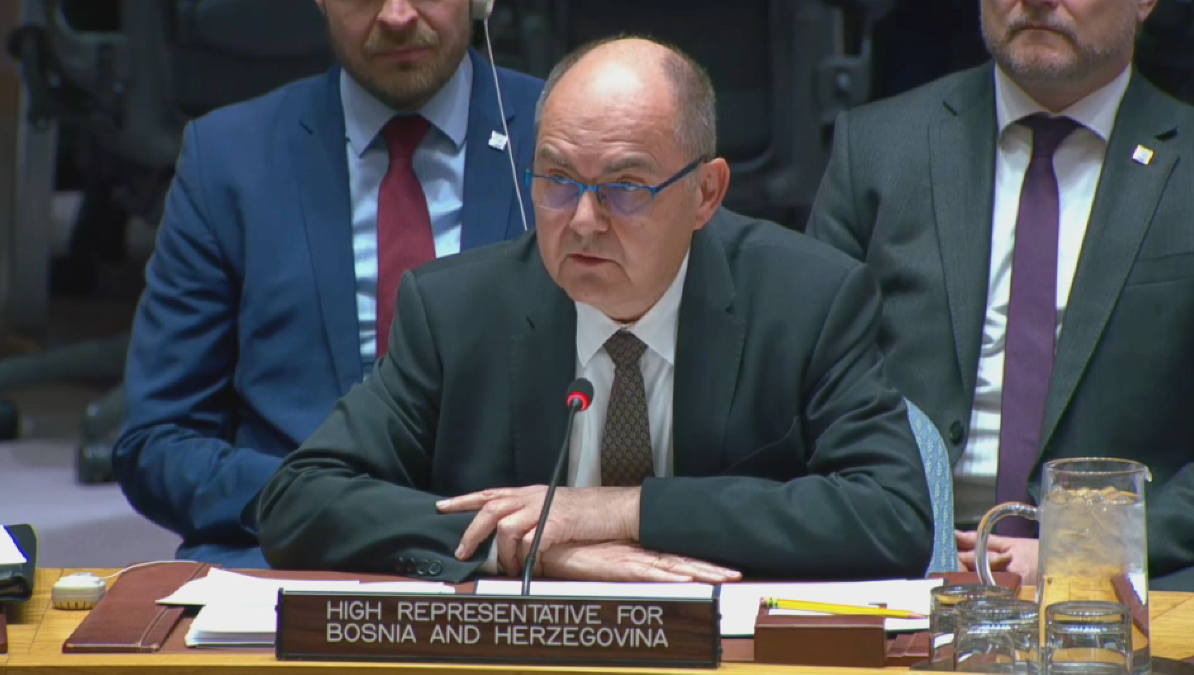
Outgoing High Representative Christian Schmidt addressed the UN Security Council today as he presented his 69th report to the UN Secretary-General on the implementation of the peace agreement in Bosnia and Herzegovina, warning that continued political obstruction is leading to the “ongoing deconstruction of the institutional order” of the country.
The report covers the period from October 16, 2025, to April 15, 2026, and comes at one of the most sensitive political moments since the signing of the Dayton Peace Agreement, following Schmidt’s announced departure and amid continued blockages of state-level institutions.
“Stable but fragile”
Schmidt said the overall security situation in Bosnia and Herzegovina remains “stable but fragile,” stressing that the stabilizing role of EUFOR, in close cooperation with the Office of the High Representative, remains relevant.
He warned that disputes over the Dayton Peace Agreement continue to affect the functioning of Bosnia’s institutions, “slowly leading to their deconstruction.”
According to Schmidt, the reporting period was also marked by a climate of distrust caused by “divisive and degrading narratives” aimed mainly at one constituent people.
RS leadership questioned
The High Representative said Bosnia and Herzegovina’s territorial integrity continues to be questioned by the leadership of Republika Srpska, whose increasingly confrontational rhetoric, he said, “openly targets Bosniaks on ethnic and religious grounds.”
He also warned that state-level institutions are being stalled by those advocating the transfer of powers to lower levels of government in order to portray Bosnia and Herzegovina as unviable.
Schmidt said state institutions created to enable the country to function as a sovereign state are being “held hostage” by actors seeking to strengthen sub-state institutions, primarily in Republika Srpska.
House of Peoples used as blockage tool
Schmidt said this trend is most visible in the House of Peoples of Bosnia’s Parliamentary Assembly, where quorum rules have been used as a “blockage mechanism.”
He noted that laws adopted by the House of Representatives remain stuck in the House of Peoples, including legislation required before Bosnia and Herzegovina can hold its first intergovernmental conference with the European Union and formally begin accession negotiations.
Other state institutions, he added, are also facing politically motivated obstruction that prevents them from fully carrying out their constitutional and legal responsibilities.
Budget used to weaken institutions
The report states that the budget of Bosnia and Herzegovina’s institutions has long been used as a tool to weaken them.
Schmidt noted that state institutions were on temporary financing throughout 2025 and again from January 2026, while their budget has remained almost unchanged for more than a decade despite growing obligations and inflation.
By contrast, he said, entity budgets have continued to increase significantly.
The chronic lack of funding, he warned, has caused problems across the board, “first and foremost” in the defence and security sectors.
BHRT crisis
Schmidt also highlighted the financial crisis at Bosnia and Herzegovina’s state broadcaster, BHRT, warning that the possible shutdown of the public broadcaster would represent another step in the “creeping deconstruction” of the state’s institutional framework.
He said the crisis shows that state-level institutions cannot survive financially when under constant pressure from the entities.
“Quiet collapse” of democratic standards
In one of the strongest parts of the report, Schmidt warned of a “quiet collapse” of democratic standards in Bosnia and Herzegovina.
He said some leading political elites are more interested in consolidating control over institutions and weakening checks and balances than in compromise, rule of law and European integration.
Corruption, he added, remains a “serious and persistent problem,” deeply embedded in public institutions and everyday life.
Election integrity concerns
Schmidt also addressed the early election for the President of Republika Srpska, held on November 23, 2025, with repeated voting on February 8, 2026, following the termination of Milorad Dodik’s mandate by a final decision of the Court of Bosnia and Herzegovina.
He said the Central Election Commission annulled results in 17 electoral units, at 136 polling stations, after determining that the election gave the ruling party an undue advantage and was marked by widespread fraud.
The vote exposed serious weaknesses in election integrity, particularly in voter identification, including false impersonation and voting without valid identification documents, he said.
Schmidt said additional safeguards, including technology for voter identification and vote counting, are essential ahead of the October 2026 general elections.
State property and media freedom
The High Representative also warned that media freedom remains constrained, particularly in Republika Srpska, citing political influence over public broadcasters and parts of the private media sector, intimidation of journalists, legal pressure, hostile rhetoric from senior officials and restricted access to official events.
He also said the unresolved issue of state property remains a major factor in Bosnia’s stagnation, arguing that the Federation of Bosnia and Herzegovina is the “primary victim” of the absence of a state-level solution.
Schmidt concluded that, despite the “ongoing deconstruction” of Bosnia’s institutional order, citizens, civil society, local authorities and the private sector continue to show “remarkable societal resilience” and could help the country break out of stagnation.
Kakvo je tvoje mišljenje o ovome?
Učestvuj u diskusiji ili pročitaj komentare


Kakvo je tvoje mišljenje o ovome?
Učestvuj u diskusiji ili pročitaj komentare